Iran Intensifies Assaults on Gulf Infrastructure Amid Escalating Conflict
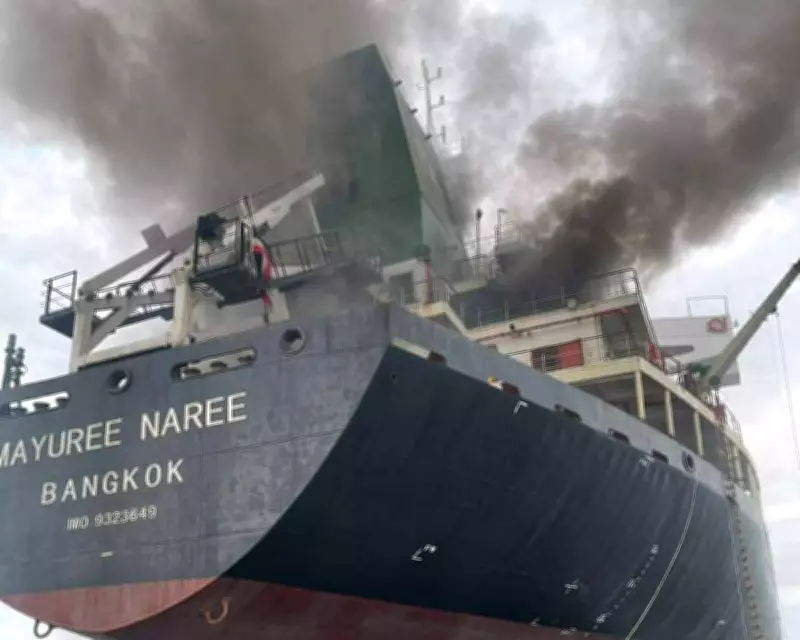
Iran has dramatically escalated its military strategy by targeting civilian infrastructure and transport networks across the Gulf region. On Wednesday, attacks were launched on commercial ships, including the Thai cargo vessel Mayuree Naree, as it navigated the strategic Strait of Hormuz. Simultaneously, Dubai's international airport was targeted, marking a significant expansion in Iran's offensive operations.
Warnings of a Protracted War and Economic Turmoil
Senior Iranian officials have adopted a defiant stance, cautioning that the conflict could evolve into a prolonged "war of attrition." They warn that this escalation threatens to trigger global economic chaos, as energy supplies from the oil and gas-rich Gulf region are severely disrupted. Ebrahim Zolfaqari, spokesperson for Iran's military command, directly addressed the US, stating, "Get ready for oil to be $200 a barrel, because the oil price depends on regional security which you have destabilised."
Regional Violence and Humanitarian Impact
The violence has spread across a broad swath of the Middle East, with Israeli strikes targeting Hezbollah positions in Lebanon and Iranian missiles, along with Hezbollah rockets, aimed at Israel. The UN refugee agency reports that at least 759,000 people have been internally displaced in Lebanon, while over 92,000 have fled into neighbouring Syria. In Lebanon, the health ministry states that Israel's offensive has resulted in 570 deaths, including 45 women and 86 children, though it does not distinguish between combatants and civilians.

Attacks on Maritime and Energy Assets
In the Gulf, three additional merchant ships were struck by unknown projectiles on Wednesday, bringing the total number of vessels reportedly hit since the conflict began to 14. Crews were evacuated from a Thai-flagged bulk freighter following an explosion and fire, while a Japanese-flagged container ship and a Marshall Islands-flagged bulk carrier also sustained damage. The Revolutionary Guard has declared that Iran will not permit "a single litre of oil" to pass through the Strait of Hormuz until the US ceases its bombing campaign.
Kuwait and Saudi Arabia reported intercepting Iranian drones, with Kuwait downing eight and Saudi Arabia intercepting five heading toward the Shaybah oil field. This disruption has led to hundreds of ships being blockaded behind the narrow channel, causing the worst energy supply disruption since the oil shocks of the 1970s.
Political and Military Developments
Iranian officials confirmed for the first time on Wednesday that the country's new leader, Mojtaba Khamenei, was wounded in airstrikes that killed his father, mother, wife, and a son. Alireza Salarian, Tehran's ambassador to Cyprus, revealed, "I have heard that he was injured in his legs and hand and arm ... I think he is in the hospital because he is injured." Meanwhile, Iran's police chief, Ahmadreza Radan, warned that any protesters within Iran would be treated "as an enemy ... All our security forces have their fingers on the trigger."
On the US and Israeli side, decision-makers appear committed to continuing the offensive. Israel's defence minister, Israel Katz, asserted that the joint campaign against Iran "will continue without any time limit, as long as required, until we achieve all objectives and win the campaign." US President Donald Trump offered mixed messages, initially calling the war a "short-term excursion" but later stating, "we haven't won enough," and on Wednesday, he told Axios the conflict would end "soon" because there is "practically nothing left to target."
International Response and Economic Measures
Governments worldwide are increasingly concerned about economic turmoil from surging oil prices, which could anger voters. The International Energy Agency (IEA) recommended releasing 400 million barrels of oil, the largest such move in its history, in an effort to restrain soaring prices. Trump praised the "tremendous impact" of decisions by Group of Seven (G7) leaders, though it was unclear what he specifically referred to.

Technological and Strategic Shifts
Admiral Brad Cooper, commander of US Central Command, noted that US strikes, including one on a "large ballistic missile manufacturing facility," have drastically reduced Iran's ballistic missile and drone attacks. He also confirmed the use of "advanced AI tools" to process vast amounts of data quickly, emphasising that "humans will always make final decisions on what to shoot and what not to shoot and when to shoot."
Casualty Figures and Ongoing Strikes
According to Iran's UN ambassador, Amir Saeid Iravani, more than 1,300 Iranian civilians have been killed since US and Israeli airstrikes began on 28 February. In Israel, explosions from air defences intercepting missiles have become routine, with sirens sending residents to shelters. Twelve people have been killed and hundreds injured by Iranian and Hezbollah attacks, with Israeli officials accusing Iran of using illegal cluster munitions against population centres.
As the conflict enters its 12th day, with no immediate resolution in sight, the situation remains volatile, with continued strikes and a growing humanitarian crisis across the region.