
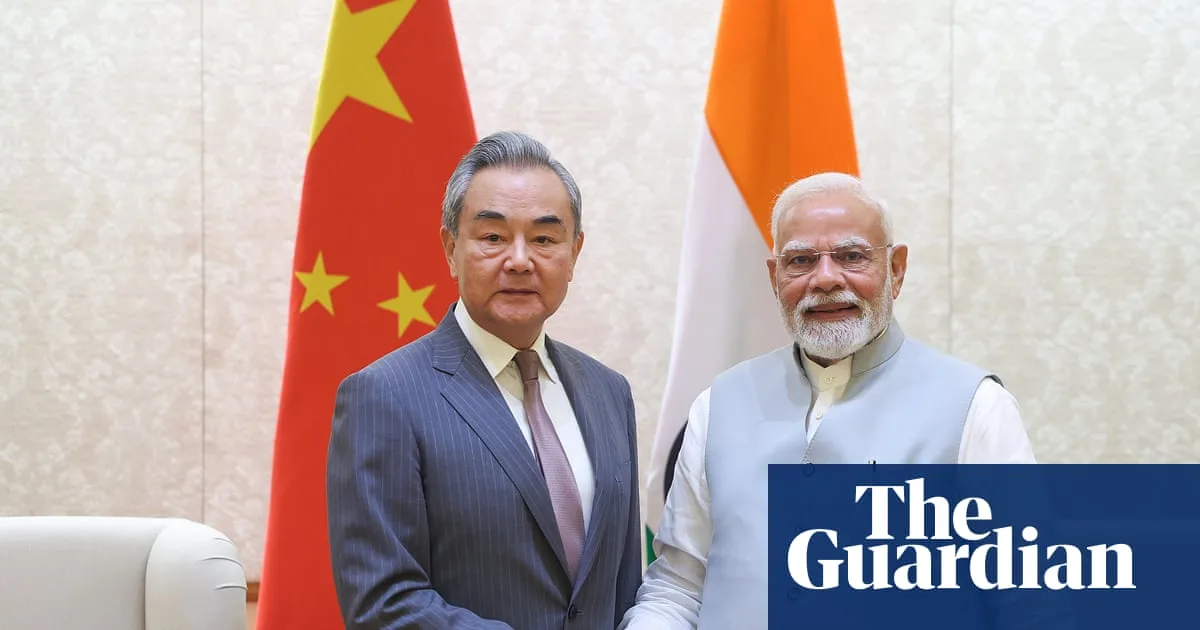
India and China have hailed “steady” progress in their fractious relationship, agreeing to resume trade and other ties and to work towards resolving the long-running Himalayan border dispute. The moves come during a global geopolitical shake-up triggered by Donald Trump’s tariff regime.
According to statements from China’s foreign ministry, the two sides agreed to resume direct flights, reiterating a pledge made in January, as well as issuing visas to journalists and facilitating business and cultural exchanges. India’s prime minister, Narendra Modi, noted “respect for each other’s interests and sensitiveness”, while Beijing said the countries had entered a “steady development track” and should “trust and support” each other.
The visit to Delhi by China’s top diplomat, Wang Yi, preceded an expected trip by Modi to Tianjin in August to meet China’s leader, Xi Jinping. Relations between the nuclear powers plummeted in 2020 after a deadly border clash in the remote Himalayas, with an official death toll of 20 Indian and four Chinese soldiers. Since then, both sides have held talks to de-escalate, agreed a pact on border patrols and withdrawn additional forces.
India’s foreign ministry said Wang met the foreign affairs minister, Subrahmanyam Jaishankar, and the national security adviser, Ajit Doval, discussing “de-escalation, delimitation and boundary affairs”. Chinese state media framed the discussion as agreeing to “explore the possibility of advancing boundary demarcation negotiations”. Wang said the “setbacks” of recent years were not in the interest of either country and that he was “heartened to see the stability now restored”, while India also raised concerns about China’s planned dam on the Yarlung Tsangpo River, which Delhi fears will affect downstream communities.
The thaw comes as Trump announced an additional 25% tariff on imports from India, set to take effect on 28 August, bringing punitive US tariffs to 50%. India called the measures “unfair, unjustified and unreasonable”. Meanwhile, a senior Russian embassy official said Russia would keep supplying oil to India and hinted at reviving a trilateral meeting with China and India. Analysts said Trump’s tariffs and a perceived reduction in US presence had accelerated stabilisation, but fundamental differences remained. After India, Wang is due to travel to Pakistan.




