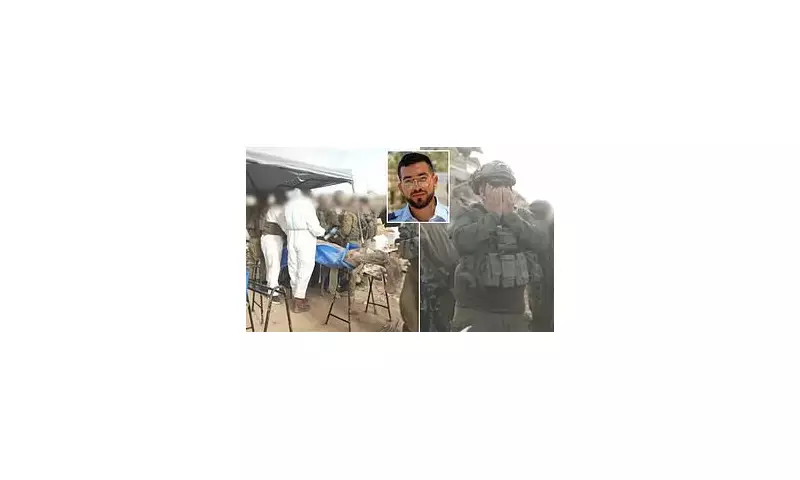
The Israel Defence Forces have published deeply moving new footage documenting the formal identification process for the body of their fallen comrade in Gaza. The video, released on Tuesday evening, captures the poignant moment when medical teams worked alongside IDF soldiers to carefully examine the remains, cross-referencing details with official identification data.
Emotional Breakdown After Identification
When the meticulous identification process concluded, soldiers present were visibly overcome with emotion, breaking down in tears as the gravity of the moment fully registered. The footage provides a raw glimpse into the human toll of conflict, showing military personnel grappling with the loss of their colleague.
The Story of Ran Gvili
Staff Sergeant Ran Gvili, a 24-year-old from Meitar who served as a Yasam Negev fighter in the Southern District of the Israel Police, was identified on Monday. His body was subsequently returned to Israeli territory, where police held a solemn farewell ceremony attended by his grieving father.

Police Commissioner Danny Levy paid tribute during the gathering, stating: 'This is a tremendous honor to stand before Rani's body and say to him, to his family, and to all police officers that the State of Israel was in grave danger on October 7 - and people like Rani went out, fought, and gave their lives for the state, serving as its protective wall.'
Heroic Actions Despite Injury
On the morning of October 7, 2023, Gvili was at home recovering from a motorcycle accident that had left him with a fractured shoulder. Despite his injuries, upon learning of the terrorist infiltration, he immediately donned his uniform and rushed to join his unit members in battle.
During his journey, he encountered terrorists and fought courageously at the entrance to Kibbutz Alumim, where he was ultimately killed. Members of the kibbutz community would later remember him as 'Ran, the Defender of Alumim' - a name that captured his final stand.
Closure for Hostage Families
With Monday's announcement of Gvili's remains being returned, none of the 251 hostages abducted more than two years ago during Hamas's attack remain in the Gaza Strip. Prime Minister Benjamin Netanyahu declared that Israel had successfully 'brought them all back.'
Hamas responded by insisting the discovery confirmed the group's 'commitment to all the requirements of the ceasefire agreement on the Gaza Strip.'
Family's Long Wait for Answers
It took several months before Israeli authorities informed Gvili's parents in January 2024 that their son had been killed on October 7 and that his body had been taken to Gaza. His father recalled to AFP in December: 'He ran to help, to save people... even though he was already injured before October 7. But that was Rani - always running forward, the first to help and the first to jump in.'
His mother, Talik Gvili, added: 'He fought until the last bullet and then he was taken hostage.'
Search and Recovery Efforts
Over the weekend, the Israel Defence Forces confirmed they were searching for Gvili's remains based on intelligence suggesting his body was buried at a Muslim cemetery in eastern Gaza City. An army statement on Monday confirmed: 'Following the identification process conducted by the National Forensic Centre, in cooperation with the Israeli police and the military rabbinate, representatives of the (Israeli military) informed the family of hostage Ran Gvili... that their loved one had been formally identified and repatriated for burial.'
The statement concluded: 'Thus, all the hostages held in the Gaza Strip have been repatriated.'
International Reactions and Next Steps
Board of Deputies President Phil Rosenberg responded to the discovery, saying: 'After 843 days of pain, we are moved and relieved at the news that Israel has located and identified the body of Ran Gvili. Never again must Israel face an onslaught of the sort it faced on 7 October.'
He continued: 'And as we move to phase two of the ceasefire we need to see the disarmament and removal of Hamas from Gaza. With terror excised from the enclave, there is no reason why Gaza cannot become a place of peace and prosperity.'

The identification and return of Gvili's body marks a significant moment in the ongoing conflict, providing closure for one family while highlighting the complex diplomatic and humanitarian challenges that remain unresolved in the region.