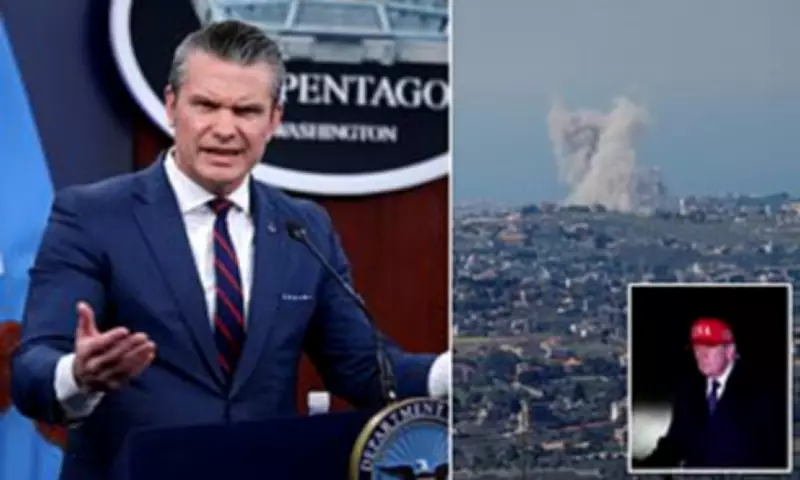
Secretary of War Pete Hegseth displayed clear impatience with journalists pressing for operational timelines regarding ongoing military actions against Iran, firmly declining to endorse or dispute President Donald Trump's publicly stated expectations.
Tense Exchange at Pentagon Briefing
During a joint press conference held at the Pentagon on Monday morning, Hegseth and Joint Chiefs of Staff Chairman Dan Caine addressed the media following a series of weekend strikes in the Middle East. These military actions coincided with the collapse of nuclear peace negotiations involving Iran, creating a volatile geopolitical backdrop.
When directly questioned about President Trump's assertion to the Daily Mail that the conflict would likely conclude within four weeks or less, Hegseth reacted with visible irritation. He characterized the inquiry as a "typical NBC sort of gotcha question," illustrating the administration's broader stance against disclosing strategic military particulars.

Administration's Stance on Operational Secrecy
Hegseth emphasized a deliberate departure from previous governmental approaches, stating unequivocally that the current administration would not disseminate minute details of war plans. He argued that excessive transparency from the Department of War inadvertently benefits American adversaries by providing them with valuable intelligence.
"President Trump has all the latitude in the world to talk about how long it may or may not take — four weeks, two weeks, six weeks. It could move up, it could move back," Hegseth retorted sharply to the NBC reporter. "We're going to execute at his command the objectives we set out to achieve."
Conflicting Public Statements and Military Reality
In his Sunday conversation with the Daily Mail, President Trump projected confidence about the operation's duration, describing it as a "four-week process." He elaborated, "We figured it will be four weeks or so. It's always been about a four-week process so - as strong as it is, it's a big country, it'll take four weeks - or less."
However, General Dan Caine, speaking alongside Hegseth, offered a more ambiguous military perspective. He confirmed that the United States strikes in Iran do not constitute a single-day operation but deliberately avoided specifying any potential timeframe for the ongoing deployment. This contrast between presidential optimism and military non-commitment underscores the complex nature of modern conflict communication.
The briefing highlighted a significant rift between the administration's public messaging and its operational secrecy protocols. Hegseth's combative response reflects a broader strategy to control narrative flow regarding military engagements, particularly in sensitive regions like the Middle East where information warfare plays a crucial role.