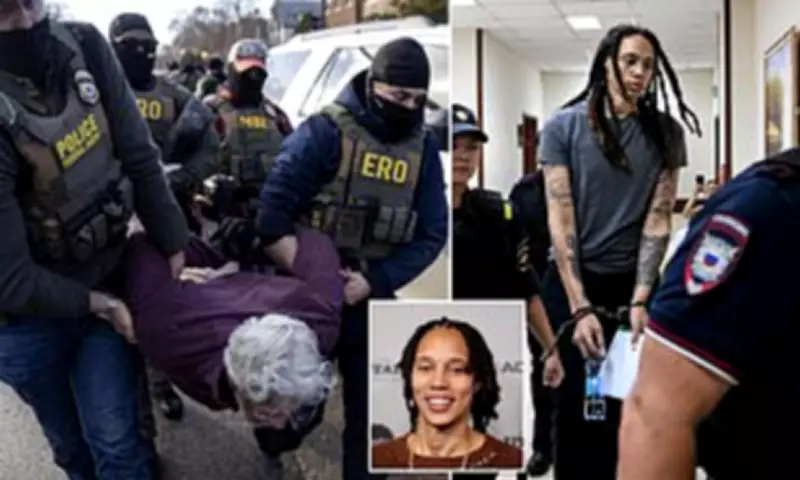
The newly released documentary detailing Brittney Griner's harrowing experience in a Russian penal colony should serve as a stark warning to Americans about the dangers of authoritarianism, according to the WNBA superstar herself. Speaking exclusively to The Hollywood Reporter ahead of Tuesday's premiere of 'The Brittney Griner Story' at the Sundance Film Festival, the celebrated NCAA and WNBA champion emphasised that she believes the project arrives at a crucial moment in American politics.
A Timely Warning Amid National Tensions
Griner explicitly connected her own arrest and imprisonment in Russia to recent violent incidents in Minneapolis, where two American citizens were killed by federal immigration agents. 'I hope this film can shed some light into what it could be like if we keep letting this happen,' Griner stated with palpable concern. 'Right now, we're in a very bad place, especially with everything that's going on in Minnesota and just across our country. I definitely think people will understand a little bit more now and be able to see some comparisons.'
From Moscow Arrest to Geopolitical Pawn
The basketball star's ordeal began in February 2022 when she was detained at a Moscow airport while returning to Russia, where she played professionally during the WNBA offseason. Customs officials claimed to have discovered a small container of cannabis oil in her luggage, which Griner later attributed to a 'mental lapse' during her packing preparations in the United States.

Unfortunately, her arrest coincided precisely with the onset of Russian President Vladimir Putin's full-scale invasion of Ukraine, transforming Griner into a significant geopolitical bargaining chip overnight. She was subsequently sentenced to nine years imprisonment in a Russian penal colony, enduring ten months of confinement before the Biden Administration secured her release through a prisoner exchange involving notorious arms dealer Viktor Bout.
Advocacy and Aftermath
Since her return to freedom, Griner has resumed her WNBA career, secured another Olympic gold medal, and become a vocal advocate for other Americans detained in Russia. She has particularly highlighted the cases of security expert and former US Marine Paul Whelan and Wall Street Journal reporter Evan Gershkovich, both of whom were fortunately released in 2024 following diplomatic negotiations by the Biden Administration.
Documentary director Alexandria Stapleton believes Griner's story carries profound political resonance for contemporary America, especially amid escalating tensions between government authorities, immigrant communities, and protest movements across the nation.
Parallels in Minneapolis Violence
The documentary's release coincides with disturbing events in Minneapolis this month, where American protestors Renee Good and Alex Pretti were both shot dead by federal immigration agents. Federal officials accused Good of attempting to run over ICE agents with her vehicle, though available video evidence contradicts this claim. Meanwhile, Pretti's killing was initially justified by authorities citing his legally registered handgun, despite witnesses confirming he wasn't holding the weapon when border agents shot him.
In the immediate aftermath, Department of Homeland Security chief Kristi Noem accused Pretti of 'attacking officers,' while Trump advisor Stephen Miller labelled him a 'would-be assassin.' Subsequently, former President Trump has promised to 'de-escalate' the situation in Minnesota and support an independent investigation into the killing.
A Broader Political Message
Griner's documentary ultimately presents more than just a personal survival narrative; it frames her experience as a cautionary tale about governmental overreach and diminishing civil liberties. By drawing direct parallels between Russian authoritarian practices and recent domestic incidents, the film encourages American audiences to critically examine power dynamics within their own borders. As political divisions deepen and enforcement tactics intensify, Griner's story serves as both a testament to resilience and a sobering reminder of how quickly ordinary citizens can become casualties of geopolitical conflicts and domestic crackdowns.