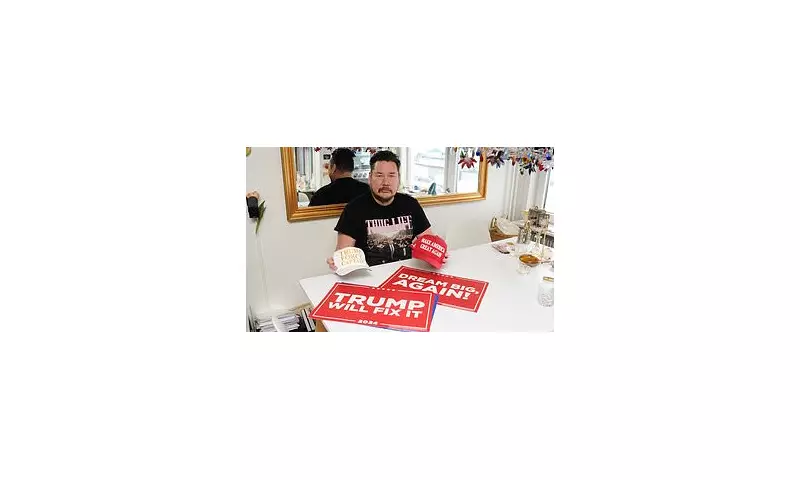
The genteel cocktail bar of Greenland's most luxurious hotel, the Hans Egede in Nuuk, is an unlikely setting for a violent political brawl. Yet that is precisely what unfolded when a local businessman, Jorgen Boassen, was knocked from his stool by a sucker punch from behind. The catalyst for the attack? His vocal support for Donald Trump's ambition to make Greenland American.
A Society Torn Apart
Boassen, a 51-year-old former boxer and bricklaying company boss, has become an unofficial ambassador for the pro-Trump cause in Greenland. He told the Mail that the political climate has grown so toxic he now seriously fears the world's largest island is on the brink of 'civil war'. Arguments over whether Greenland should remain part of Denmark after 300 years or agree to U.S. annexation have become rancorous, tearing families apart.
Boassen's own life exemplifies the schism. He claims he was forced to split from his fiancée, with whom he shared a home and a teenage daughter in Nuuk, because her family despised his campaign for Americanisation. He further alleges it was no coincidence that his partner was later fired from her senior post at the nationalised airline, Air Greenland, after 30 years, soon after he attended MAGA events in Washington.

'The Danes control 95 per cent of all the businesses here, and they are hunting down people like me,' Boassen stated from his current base in Copenhagen. His company has closed after being blacklisted, he claims, and a climate of fear silences others who share his views.
From Colonial Past to an Uncertain Future
The debate over sovereignty has been thrown into sharp relief by the Trump administration's overtures. White House officials, including Stephen Miller, have flatly declared Greenland 'should be part of the United States' for national security reasons, while Secretary of State Marco Rubio plans talks about a potential purchase.
This has triggered deep anxiety among many of Greenland's 57,000 inhabitants. Hedvig Frederiksen, a 65-year-old retiree in Nuuk, now jumps at the sound of aircraft, fearing an American invasion since Trump's operation in Venezuela. She has an aircraft tracking app to monitor flights from the U.S. Pituffik Space Base.
Her views are shaped by a painful colonial history under Denmark. At age 14, she was fitted with a contraceptive coil without parental consent as part of a now-exposed Danish policy to limit the Inuit population. Yet, stories from her mother's generation also speak of American kindness when the U.S. protected Greenland during WWII, providing fabrics and sweets—a stark contrast to Danish restrictions.
Cultural Chasm and the Trump Factor
While a poll last year showed 84% of Greenlanders favour independence from Denmark, this does not translate to a desire for American rule, particularly under Trump. His 'drill-baby-drill' mantra and brash persona are anathema to the unassuming Inuit culture, raising fears for the pristine environment.
'It's just the way he talks and acts,' said Hedvig's daughter, Aviaja Fontain, 40. 'We Greenlanders can shout when we need to, but our culture is to be quieter.' She worries American influence would lower moral standards and introduce horrors like school shootings.
Pro-independence MP Kuno Fencker agrees divisions are fractious, with 'families falling out'. He sees potential in a 'free association' deal with the U.S., like the Marshall Islands, allowing Greenland sovereignty while letting American firms exploit rare earth minerals and maintain military bases to deter China and Russia—a task he says is 'palpably far beyond the Danes'.
As Boassen darkly notes, the potential for violent conflict exists because 'in Greenland almost every home has a gun for hunting'. Whether the island's future is decided in Washington, Copenhagen, or Nuuk, the social fabric of this vast, icy land is already under severe strain.