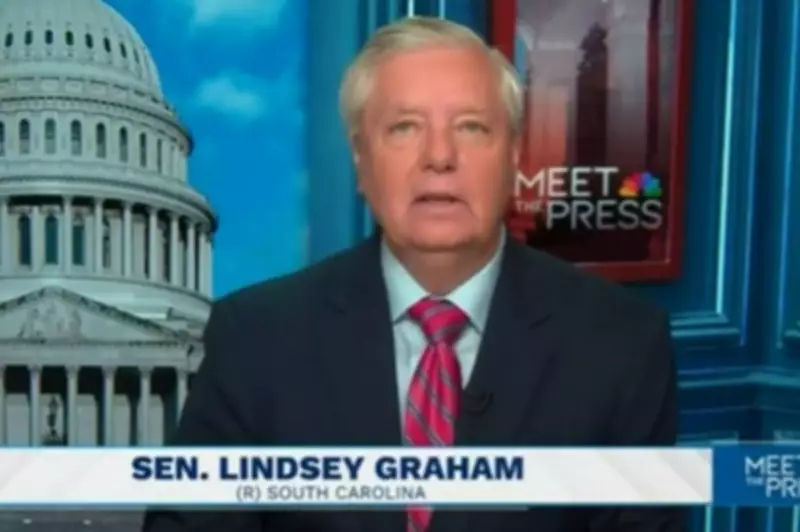
Senior Republican Senator Lindsey Graham has firmly rejected the notion that the United States requires a comprehensive plan to manage Iran's political future following the confirmed death of Supreme Leader Ayatollah Khamenei in a joint US-Israeli military strike. The South Carolina lawmaker, a longstanding advocate for military confrontation with Tehran, appeared on NBC's Meet the Press to address the escalating crisis.
Graham Dismisses Responsibility for Post-Strike Planning
During his Sunday interview, Graham vehemently disputed suggestions that the Trump administration bears responsibility for shaping whatever government might emerge from the potential collapse of Iran's theocratic regime. "Our goal is to make sure Iran cannot become again the largest state sponsor of terrorism," Graham declared, emphasizing that the Iranian people themselves should determine their nation's new direction.
When pressed by moderator Kristen Welker about whether President Trump possessed a specific plan to guarantee this outcome, Graham responded emphatically: "No! It's not his job or my job to do this. How many times do I have to tell you? Our job is to make sure Iran is no longer the largest state sponsor of terrorism. To help the people reconstruct a new government. No boots on the ground."

Cotton Clarifies Military Posture
Fellow Republican Senator Tom Cotton, who chairs the Senate Intelligence Committee, provided additional clarification during a separate appearance on CBS's Face the Nation. While supporting the administration's actions, Cotton stated that President Trump has "no plan for any kind of large-scale ground force inside of Iran."
However, Cotton did not completely rule out limited military operations, suggesting that search-and-rescue missions for downed pilots might be conducted if necessary. He characterized the ongoing campaign as primarily an air- and sea-based assault, indicating this approach would continue in coming days.
Strike Details and Regional Fallout
The coordinated strikes, which began in the early hours of Saturday morning, have resulted in significant casualties beyond the supreme leader's death. Iranian state television has confirmed Khamenei's demise, while other reports indicate former hardline president Mahmoud Ahmadinejad may have been killed, though this remains unverified by prominent officials.
The conflict has already claimed three American service members' lives since hostilities erupted, with Iran launching retaliatory missile attacks across the region. One particularly devastating strike hit a girls' school in southern Iran, killing 148 people and wounding dozens more in what represents the largest mass casualty event since the conflict began.
Diplomatic Background Revealed
New reporting indicates the strikes followed closely after failed negotiations in Geneva on Thursday aimed at resolving US demands regarding Iran's nuclear and ballistic weapons programs. According to sources familiar with the discussions, planning for the military action including Khamenei's assassination began weeks earlier during Israeli Prime Minister Benjamin Netanyahu's visit to Mar-a-Lago.
The Geneva talks represented a final diplomatic effort to avert military confrontation, with US negotiators Jared Kushner and Steve Witkoff reportedly emerging from evening sessions to inform President Trump that Iran remained far from meeting Washington's substantial demands. These demands offered only limited sanctions relief in exchange for sustained future compliance with US conditions.
"If the Iranians had come to Geneva and given Trump what he wanted, he would have pulled the brakes on the military track," an Israeli official revealed. "But they were arrogant and thought he wouldn't take action." President Trump subsequently ordered the attacks just one day after the negotiations concluded.
As the situation continues to develop, key Iranian figures including President Masoud Pezeshkian remain in power, and the country's military persists with missile attacks throughout the region even as US and Israeli strikes continue. The conflict has already produced casualties in multiple Middle Eastern nations including Israel and the United Arab Emirates, signaling potential for broader regional escalation.