German Chancellor Merz Arrives in Beijing for High-Stakes Diplomatic Talks
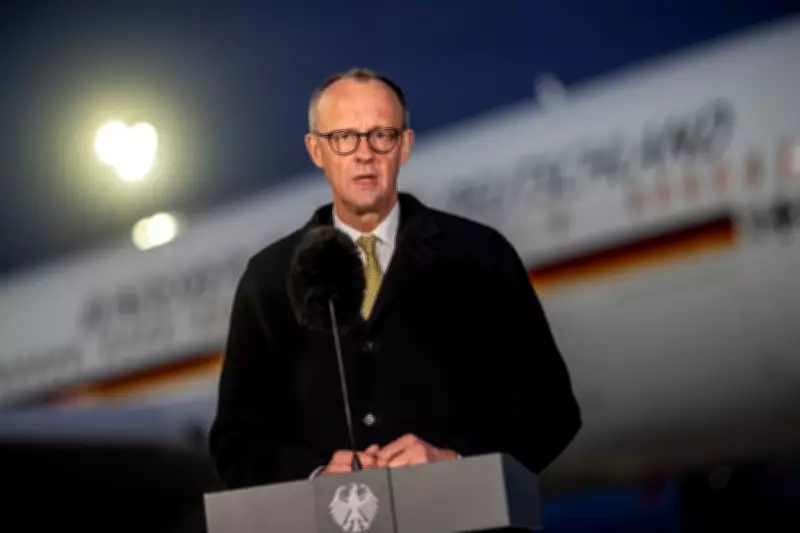
German Chancellor Friedrich Merz has landed in the Chinese capital, commencing a critical two-day visit aimed at addressing pressing economic and geopolitical issues. His agenda focuses on securing a fairer trade environment for German businesses and urging China to play a more active role in resolving the ongoing conflict in Ukraine, now in its fourth year.
European Unity and Strategic Messaging
Before departing, Chancellor Merz emphasized the European context of his mission, noting that his trip follows recent visits by French President Emmanuel Macron and British Prime Minister Keir Starmer, with U.S. President Donald Trump scheduled to arrive in early April. "Our message from a European point of view is the same: We want partnership with China balanced, reliable, regulated and fair," Merz stated. "This is our offer. At the same time, it is what we also hope for and expect from the Chinese side."
This visit marks Merz's first to China since assuming office in May last year. He has been a vocal advocate for a stronger, more unified Europe capable of asserting itself in a shifting global landscape. Europe faces challenges from Trump's tariff policies and demands for increased security responsibility, including the contentious issue of Greenland's control.

Global Cooperation and the Ukraine Crisis
Merz highlighted that despite differences, global problems cannot be solved without China's involvement. "The big global political problems can no longer be tackled today without involving Beijing," he remarked, adding that cooperation is essential for crises like the war in Ukraine, where "Beijing’s voice is heard, including in Moscow."
European governments have expressed frustration over China's limited pressure on Russia to end hostilities. China maintains robust trade and diplomatic ties with Russia, claiming impartiality. Chinese Foreign Ministry spokesperson Mao Ning recently said, "We hope all parties will seize the opportunity to reach a comprehensive, lasting and binding peace agreement."
Economic Tensions and Trade Imbalances
Merz joins a series of world leaders visiting Beijing as China seeks allies against Trump's tariff-driven demands and challenges to post-World War II international institutions. China's official Xinhua News Agency commented, "At a time when the world is experiencing turbulence and transformation, China and Germany, as major economies and advocates of multilateralism, share the responsibility to uphold the stability of global industrial and supply chains and oppose protectionism and economic coercion."
Economically, Europe is grappling with a surge in Chinese exports threatening manufacturing jobs. Last year, Germany's imports from China rose 8.8% to 170.6 billion euros, while exports to China fell 9.7% to 81.3 billion euros. European leaders urge Chinese companies to establish local factories and address overcapacity in sectors like electric vehicles and solar panels, which depress prices.
Merz plans to discuss remedies for systemic overcapacities and market access barriers. "We also want to discuss how we can find a remedy, for example, where systemic overcapacities have arisen, where there are export restrictions and where there are access restrictions … that distort and prevent competition," he explained.
This diplomatic engagement underscores the complex interplay of trade, security, and global governance as major powers navigate an evolving world order.