Ceasefire Violations Jeopardise Post-War Gaza Governance, Warns Diplomat
The senior diplomat responsible for monitoring the US-brokered ceasefire in Gaza has issued a stark warning that persistent breaches of the agreement are creating significant hurdles for the Palestinian committee designated to manage postwar governance and reconstruction efforts. Nickolay Mladenov, serving as high representative for Gaza under the US-established Board of Peace, delivered this caution during a panel discussion at the Munich Security Conference on Friday.
Obstacles to Transitional Governance
Mladenov emphasised that the transitional committee, composed of Palestinian administrators, has convened in Egypt but remains unable to enter Gaza. He asserted that its work cannot proceed unless Hamas, the militant group that has controlled Gaza since 2007, relinquishes institutional authority. Additionally, he called for enhanced aid delivery and improved security measures to support the fragile peace process.
The ceasefire agreement stipulates that Hamas must disarm and an international security force be deployed, yet no visible progress has been made on either front. Israel has continued to conduct strikes in retaliation for what it describes as truce violations, while Palestinian militants have also attacked Israeli forces, exacerbating tensions.
Urgent Calls for Compliance
"We need to make sure that what is happening now with the violations of the ceasefire stops," Mladenov stated. "We’re only embarrassing the committee and ultimately making it ineffective." Although he did not provide a specific timeline, he stressed that "all of this needs to move very fast" to prevent further destabilisation.
Palestinian Foreign Minister Varsen Aghabekian Shahin, speaking at the same panel, highlighted the critical importance of timing, noting that Gaza must not be severed from the Israeli-occupied West Bank. The Palestinian Authority aims to govern both territories in pursuit of eventual statehood, a goal Israel firmly opposes.
Background and Casualties
The ceasefire, brokered by the US on October 10, sought to end a conflict that had raged for over two years between Israel and Hamas. While the most intense fighting has diminished, the truce has been marred by near-daily Israeli fire, including repeated airstrikes and shootings near military-held zones. According to Gaza health officials, 591 Palestinians have been killed since the ceasefire began. The ministry, part of the Hamas-led government, maintains casualty records generally regarded as reliable by UN agencies and independent experts, though it does not distinguish between civilians and militants.
Militants have conducted shooting attacks on troops, and Israel justifies its strikes as responses to these and other violations. Four Israeli soldiers have been killed in the ongoing clashes.
Diplomatic Appointments and Humanitarian Issues
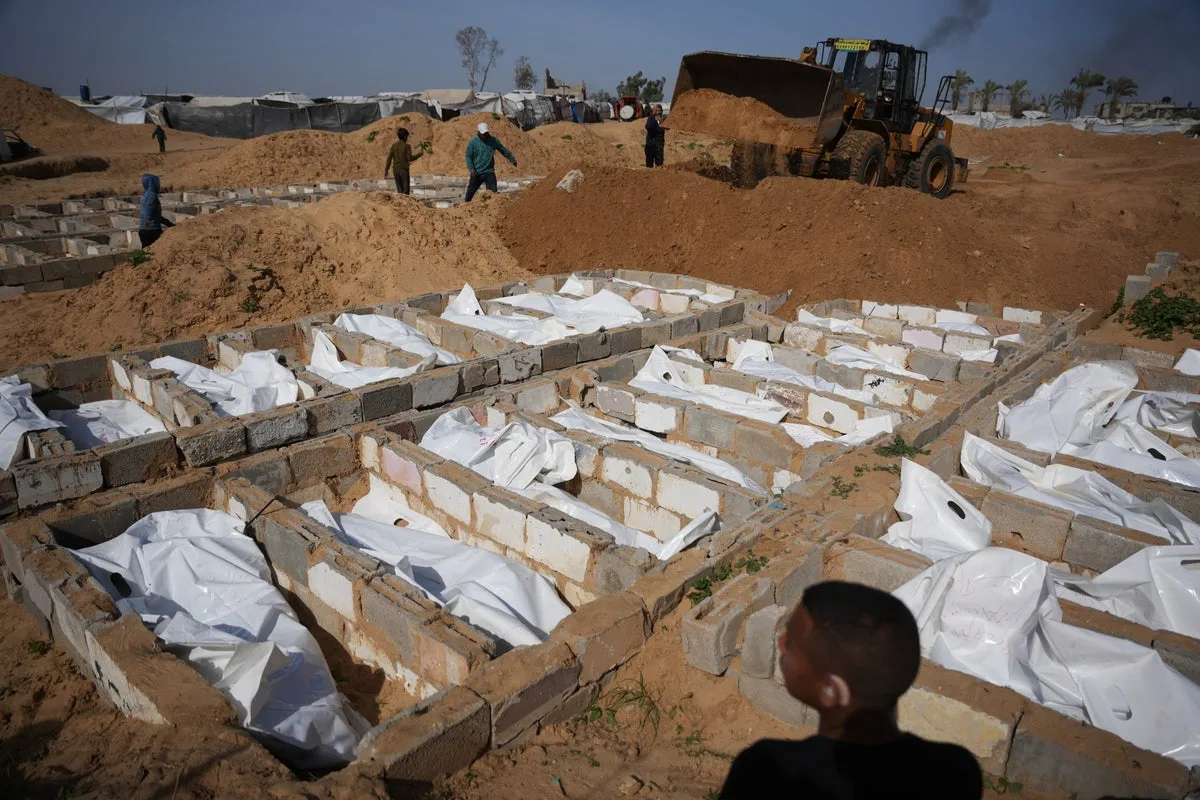
Israeli Prime Minister Benjamin Netanyahu recently announced Mladenov, a Bulgarian diplomat, as director-general of the board overseeing implementation of the second, more complex phase of the ceasefire. In a related development, the bodies of 53 unidentified Palestinians and 86 unidentified human remains were buried in a mass grave in Deir Al-Balah, central Gaza, on Friday. Earlier this month, Israel transferred 54 Palestinian bodies and 66 boxes of unidentified remains to Gaza via the Red Cross, with only one body identified by family. Israel has not provided identification for the bodies and prohibits DNA testing materials from entering Gaza.
Ziyad Obeid, director of the cemeteries department at the Endowments Ministry, explained from the burial site, "A period of time is allotted for families to identify these bodies and remains. Unfortunately, none of these remains or organs were identified."