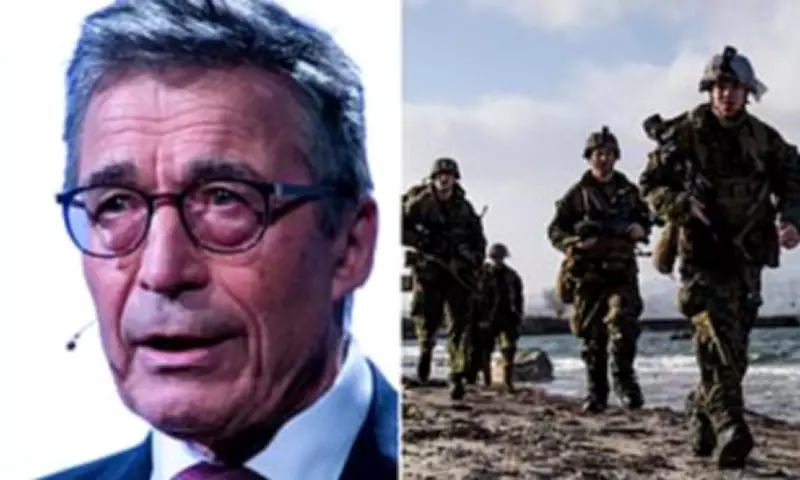
Britain and France should spearhead a new 'European Nato' coalition to assume responsibility for Europe's defence independently of the United States, according to former Nato Secretary-General Anders Fogh Rasmussen. Speaking to the Telegraph, Rasmussen, who led the alliance from 2009 to 2014, argued that a revamped security architecture is essential following President Donald Trump's threats to withdraw from Nato.
Expanding the Coalition of the Willing
Rasmussen proposed expanding the Coalition of the Willing—a 35-nation alliance established to defend Ukraine in the event of a ceasefire—so it can take over Europe's conventional defence role. He identified France and Britain as the leading members due to their nuclear capabilities. Currently headquartered in Paris, the coalition plans to relocate to London after its first year of operation.
The coalition, which includes Kyiv, is preparing a post-war deployment to deter further Russian aggression against Ukraine. However, Rasmussen argued its scope should extend beyond Ukraine to address broader continental security. He described Ukraine as an 'asset' within the coalition but stressed that regardless of peace negotiations, the country will require a 'bulwark' against Russian aggression.

Strengthening the European Pillar of Nato
Rasmussen's comments come amid President Trump's expressed 'doubts' about his commitment to Nato and Article 5—the mutual defence clause stating an attack on one member is an attack on all. He asserted that the European pillar of Nato must be strengthened. Rasmussen said, 'That's why I think we should include Ukraine in a new European security architecture, and by that, we can strengthen Nato.'
He argued that the Coalition of the Willing is necessary because he does not 'want to include hesitant countries' that belong to other alliances, such as the European Union (EU). Several EU member states, including Austria and Ireland, maintain military neutrality, while others are seen as more sympathetic to Moscow. Nations like Britain, Norway, and Turkey are not EU members but are key Nato allies.
Renewed Debate on European Security
Rasmussen's proposal adds to the renewed debate over Europe's future security architecture following Trump's criticism of European Nato allies for declining to support his war in Iran. Trump previously described the coalition as a 'paper tiger' and said withdrawing from it was 'beyond reconsideration,' raising doubts about whether the US president would authorise military support for European allies if Article 5 were invoked.
EU member states have been considering the strength and practicality of the bloc's mutual defence clause, Article 42.7, enshrined in the Lisbon Treaty. However, Rasmussen described it as 'weaker' than Article 5, stating, 'The European Union, as such, does not have the military capabilities needed to actually implement 42.7.' He dismissed proposals by Andrius Kubilius, the EU's defence commissioner, for a European security council as 'fluffy,' insisting that the 'hard defence of Europe' requires a group of nations that are 'capable and willing' to do what is needed.
A Transactional Approach to the US
Rasmussen also argued that Europe should not be reluctant to support Trump's war in Iran. He suggested Europe could offer to help secure the reopening of the Strait of Hormuz in exchange for a reduction in US trade tariffs, describing a 'transactional' approach as appropriate because that is how 'allies work together.' He proposed Europe's approach to Trump should be: 'We're in this together. We are willing to help you, provided that you will stay engaged in Europe, including supporting Ukraine, and we don't understand why you are imposing tariffs on your allies.'
Coalition Would Complement, Not Replace, Nato
Rasmussen emphasised that new defensive coalitions would not replace Nato but work alongside it, with the US assuming a leadership role. He said that while the Coalition of the Willing might take responsibility for Europe's conventional defence, an overarching 'nuclear umbrella' would still be provided by the US. He added that the coalition would require a 'Supreme Allied Commander' in Europe, who must be an American.