Editorial: US Must Halt Iran War If Victory Is Assured
If the conflict with Iran has indeed been secured, the United States has a moral and strategic imperative to immediately cease its military operations. America's recent deadly assaults on civilian infrastructure—including the destruction of Iran's tallest bridge and a leading public health facility—demonstrate not only a growing disregard for human life but also that Donald Trump's war is being unnecessarily prolonged. The time has come to end this devastating engagement.
Trump's Rhetoric and Escalating Violence
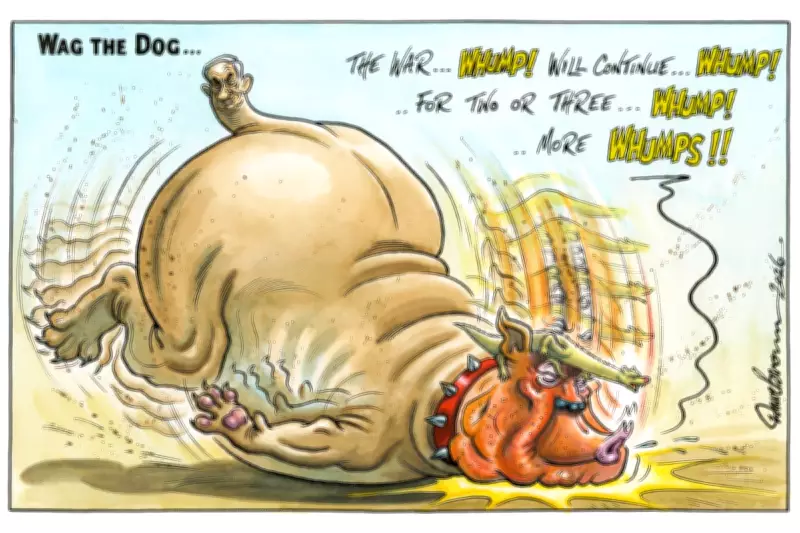
As with much of Donald Trump's communication, the full gravity of his statements often requires time to fully comprehend, given the world's desensitization to his extremes. His latest disjointed address to the American people, providing an "update" on the disastrous war with Iran and its violent aftermath, is a prime example. In his characteristically vengeful manner, Mr. Trump outlined new tactics: "We're going to hit them extremely hard over the next two to three weeks—we're going to bring them back to the Stone Ages, where they belong."
This may sound like typical Trumpian hyperbole, the kind often taken seriously but not literally. In reality, it constitutes an open declaration that the U.S. government intends to commit war crimes in what is already widely condemned as an illegal conflict. This callous, even sadistic, indifference to human life has been displayed previously. Just days ago, Mr. Trump mused that if Iranians did not comply with his demands, American forces would continue "bombing our little hearts out." He even suggested bombing the Kharg Island oil facility—a civilian target—"just for fun," mistakenly referring to it as an "excursion" instead of an incursion.

Civilian Infrastructure Under Attack
The consequences of this rhetoric are tragically clear. Iran's tallest bridge, a critical piece of civilian infrastructure and the highest in the Middle East, was reduced to rubble, claiming eight innocent lives and causing numerous casualties according to Iranian authorities. Similarly, Tehran's century-old Pasteur Institute, a premier public health center, has been obliterated. Mr. Trump openly expresses his intent to destroy oil facilities, power stations, and desalination plants, though these are less vital in Iran than in Gulf states.
Collateral damage has been extensive across Iranian cities, including a girls' primary school in Tehran and incidents like a bunker blaster hitting a munitions dump in Isfahan. While some targets may have military value, there is little evidence that the U.S. made efforts to warn civilians or minimize casualties. If the U.S. were a party to the International Criminal Court, those responsible for this campaign would likely face prosecution.
Prolonged Conflict and Strategic Confusion
The war is being extended unnecessarily, well beyond multiple points where President Trump claimed victory. Its endpoint remains uncertain, highlighting the confused, illegal, and immoral nature of the ongoing operations. If the war has been won, why does America continue to fight? Suspicion arises that Mr. Trump is supporting Israel's objective to degrade Iran's economic and industrial base, along with its military capabilities—a long-term goal of Benjamin Netanyahu.
From an American national interest perspective, this seems pointless. There is no prospect of recovering the 400kg of enriched uranium hidden somewhere, a goal Mr. Trump has inexplicably dismissed despite it being a declared war aim that might have garnered public support. Regime change is not intended; instead, the war has fortified the Islamic Republic's leaders and increased their militancy. Mr. Trump boasts of a more amenable new leadership, but evidence is scarce.

Recent Developments and Historical Parallels
On Friday, the White House confirmed the president was briefed about a U.S. F-15E Strike Eagle shot down over Iran, a propaganda win for Tehran with images of an ejection seat displayed and a bounty offered for a missing crew member. A peaceful resolution appears elusive as Iran trades oil more freely and blockades the Strait of Hormuz, holding the global economy hostage. Mr. Trump has declined to free the waterway, instead urging NATO and others to address the crisis while ordering new sorties on targets reportedly chosen by artificial intelligence.
Concerns among Pentagon leadership about the war's conduct may have influenced recent sackings of senior Defense Department officials and clashes over its "warrior" ethos. Senior military personnel are unlikely pleased with the president's gleeful warmongering or violations of war rules, nor with "secretary of war" Pete Hegseth's portrayal of the campaign as a blend of medieval crusade, Hollywood film, and video game.
Mr. Trump's phrase "bomb them back to the Stone Ages" echoes U.S. Air Force General Curtis LeMay from the Vietnam War era—a commander Mr. Trump would admire. However, the carpet bombing of North Vietnam, involving napalm and wanton destruction of civilian lives and infrastructure, did not end well for America. Then, as now, bombing civilians cannot secure victory; asymmetric warfare can still defeat a superpower despite its military might. It is time to end this conflict.