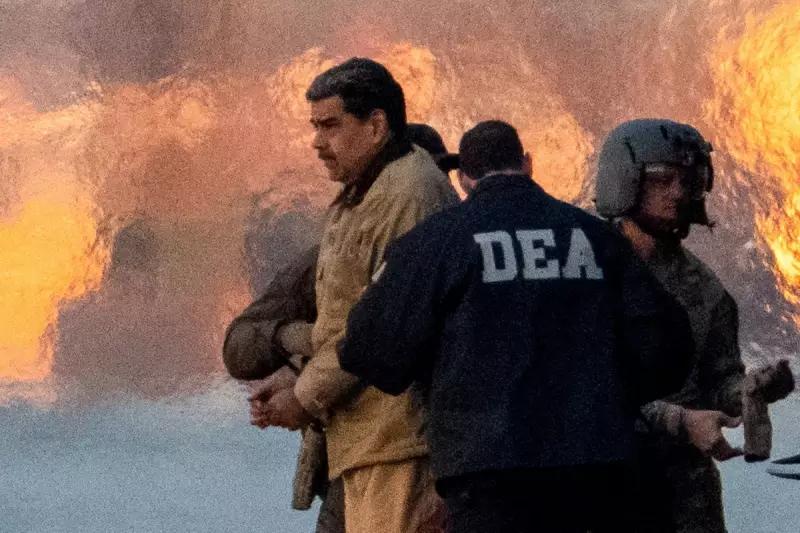
Senior figures from the Trump administration were hauled before Congressional leaders to explain a covert military operation in Venezuela that led to the capture of the country's leader, Nicolas Maduro. The high-stakes briefing came just hours after Maduro himself pleaded not guilty to serious charges in a New York courtroom.
Key Officials Face Scrutiny in Closed-Door Meeting
The briefing was conducted by a powerful trio from President Trump's cabinet: Attorney General Pam Bondi, Defense Secretary Pete Hegseth, and Secretary of State Marco Rubio. They met with Congressional leaders to detail the operation that resulted in Maduro's apprehension. The administration has characterised the mission as a law enforcement action, involving agencies including the Department of Justice (DOJ), the FBI, and the DEA.
However, this justification has done little to quell anger on Capitol Hill. Many lawmakers are deeply concerned that they were not informed in advance about what was clearly a large-scale military operation on foreign soil. President Trump defended the decision to bypass Congress, stating bluntly that "Congress has a tendency to leak."

Bipartisan Fury Over Secrecy
The frustration crosses party lines. In a rare show of unity, Republican Senator Chuck Grassley and Democratic Senator Dick Durbin issued a joint statement condemning their exclusion from the initial closed-door meeting. The senators asserted there was "no legitimate reason" for them to have been left out of the loop on such a significant matter of state.
Their statement underscores a growing constitutional tension between the executive and legislative branches over the authority to authorise foreign interventions. The incident has sparked a fresh debate about transparency and the limits of presidential power in matters of defence and international law enforcement.
Maduro's Court Appearance and Claims
The Congressional drama unfolded against the backdrop of dramatic legal proceedings in Manhattan. Earlier on Tuesday 06 January 2026, Nicolas Maduro and his co-defendant Flores appeared in a federal court to plead not guilty to charges of drug trafficking and weapons offences.
During the hearing, Maduro made the explosive claim that he was captured by U.S. forces, directly contradicting any suggestion of a consensual extradition. Meanwhile, in Venezuela, the interim president condemned the kidnapping of Maduro as she was sworn into office, highlighting the ongoing political turmoil in the South American nation.
The sequence of events—from a secretive raid to a fraught court appearance and a contentious Congressional briefing—paints a picture of a high-risk foreign policy manoeuvre that has succeeded in its immediate goal but has ignited a fierce political firestorm at home.