China has issued a stark warning to Australia, threatening new economic sanctions should the Albanese government proceed with its election pledge to reclaim control of the strategically vital Port of Darwin.
Diplomatic Tensions Over Strategic Asset
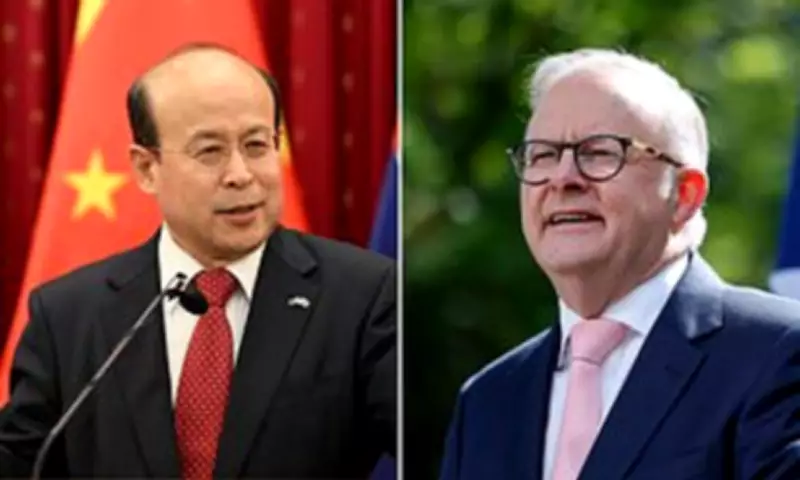
Prime Minister Anthony Albanese committed during the 2025 federal election campaign to return the port to Australian ownership, despite it being under a 99-year lease to the Chinese firm Landbridge. The Northern Territory government originally leased the port in 2015, a move that immediately sparked national security concerns regarding one of Australia's most important strategic assets.
Ambassador's Direct Warning
Chinese Ambassador to Australia Xiao Qian delivered the warning during a press briefing at the Chinese Embassy in Canberra. He confirmed that discussions between the two governments have taken place and stated Beijing is 'watching closely'.

'If anything happens, like the port will be taken back by force or forceful measures, then we have obligation to take measures to protect the Chinese company's issues. This is our position,' Ambassador Xiao told reporters.
He elaborated on the potential consequences, suggesting that 'should Landbridge be forced to leave that port, I think it might also affect the substantive investment co-operation trade between Chinese companies with that part of Australia. That is not in any interest of Australia.'
The ambassador expressed hope that the situation would not deteriorate to a point where 'the Chinese side has to do something'.
Historical Context of Trade Sanctions
This warning carries significant weight given recent history. China last imposed sweeping trade sanctions on Australian exports in 2020, following the previous Morrison government's call for an international inquiry into the origins of the COVID-19 pandemic. Those sanctions were estimated to be worth approximately $20 billion.
Beijing progressively removed most of these sanctions after the Labor Party came to office in 2022, marking a thaw in diplomatic relations. Ambassador Xiao emphasised that Australia and China are 'friends not adversaries', while simultaneously issuing a separate, firm warning regarding Taiwan.
Bipartisan Support for Reclamation
The push to regain control of the Port of Darwin has enjoyed bipartisan political support in Australia. Both the Labor Party and the Coalition promised during the election campaign to bring the port back under Australian ownership.
Prime Minister Albanese reiterated his commitment to this pledge during a recent visit to Darwin, noting that 'there are commercial negotiations and those commercial negotiations are continuing'. A final deal has yet to be reached.
National Security Assessment Underway
Assistant Defence Minister Peter Khalil confirmed that the National Security Committee is actively assessing the situation surrounding the port. 'There'll be announcements made from the government when the time is right,' he stated in an interview with ABC News.
Expert Analysis on Likely Outcomes
Graeme Smith, an associate professor at the Australian National University, provided analysis on the government's motivations and China's likely response. He suggested that while Prime Minister Albanese is unlikely to be taking this step 'solely for political gain', there is a 'performative element' to the action.
Professor Smith warned that 'China will have to do something if we (Australia) take back the Port of Darwin and trade sanctions do look the most likely to happen now.'
The Taiwan Question Looms
Ambassador Xiao's comments also touched on the sensitive issue of Taiwan, which Beijing considers an inalienable part of its territory. While noting flexibility on issues like trade, he was unequivocal regarding Taiwan.
'We're somewhat flexible in managing some of the issues or differences in our two countries, for example, trade relations ... but Taiwan is not a question that we can compromise or be flexible,' he stated.

Australia's official position, established in a 1972 joint communique, is to 'acknowledge' the position of the Chinese government regarding Taiwan, without formally accepting Beijing's territorial claim. Australia does not recognise Taiwan as a sovereign state but maintains unofficial diplomatic and trade contacts.
The situation places the Albanese government in a delicate diplomatic position, balancing a domestic election promise concerning a key strategic asset against the risk of renewed economic retaliation from one of its largest trading partners.