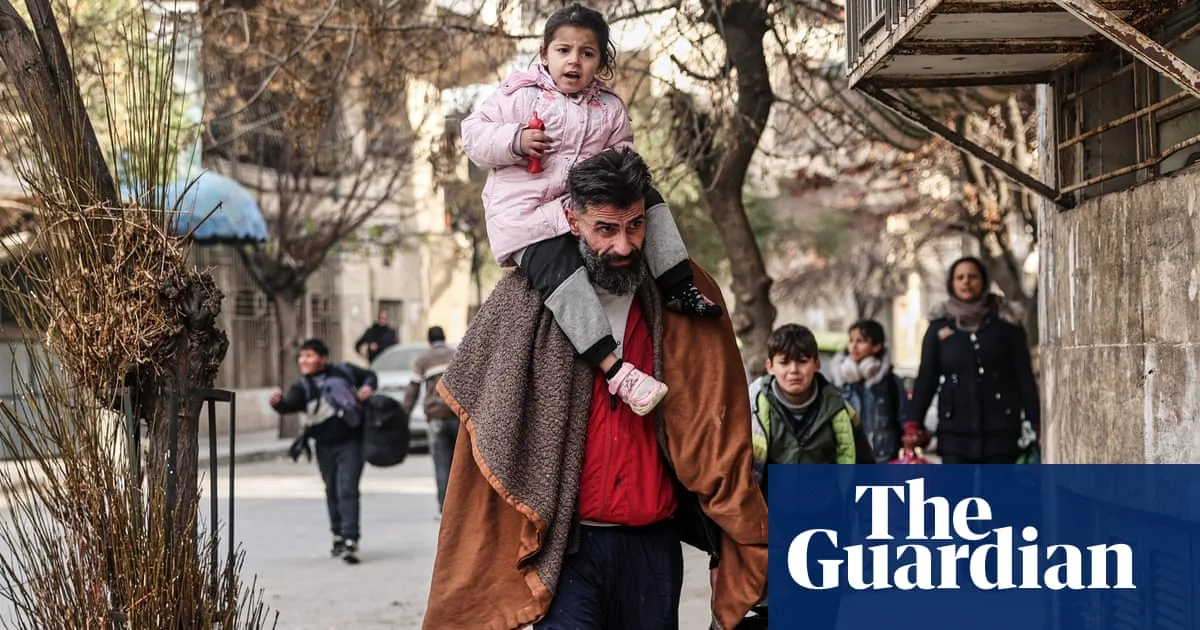
The Syrian army has ordered civilians to evacuate three contested neighbourhoods in Aleppo as fighting with Kurdish forces enters its third day, raising fears of a wider conflict between the government and US-backed Kurdish authorities. The areas of Sheikh Maqsoud, Ashrafieh and Bani Zeid were given a deadline of 1:30pm local time on Thursday, after which the army said it would begin military operations against the Kurdish-led Syrian Democratic Forces (SDF). Humanitarian corridors and shelters were opened to facilitate the evacuations.
Shortly after the deadline expired, shelling began from both sides. The clashes represent the most intense fighting in Syria since the fall of the Assad regime in December 2024, and have sparked concerns of a broader confrontation between the government and the SDF, which controls nearly a third of Syrian territory. Despite a March 2025 agreement for the SDF to merge into the Syrian army, progress has stalled, and this week's three-day battle is the longest open conflict since the deal was signed.
About 140,000 civilians have been displaced since Tuesday, according to Aleppo's directorate of social affairs and labour. At least eight civilians have been killed in Kurdish-majority neighbourhoods, and seven civilians and one soldier in government-controlled areas, with dozens wounded on both sides. The SDF denies having fighters in the neighbourhoods, describing them as local self-defence forces, while the Syrian government accuses the SDF of using civilians as human shields.
Both sides have accused each other of human rights violations. The Syrian government claims the SDF prevented civilians from evacuating and shot at those who tried, while the SDF shared videos of what it says is government shelling of a hospital and residential areas in Sheikh Maqsoud. Many displaced people have fled to other provinces, while others have taken shelter in mosques and churches.
At the root of the conflict are ongoing disagreements over the SDF's status in post-Assad Syria. The SDF seeks autonomy and has become more reluctant to disarm following recent massacres on Syria's coast and in Druze-majority areas. A meeting on Sunday between Damascus and the SDF yielded no progress, and a US state department official urged restraint, saying the US envoy is mediating between the two sides.