
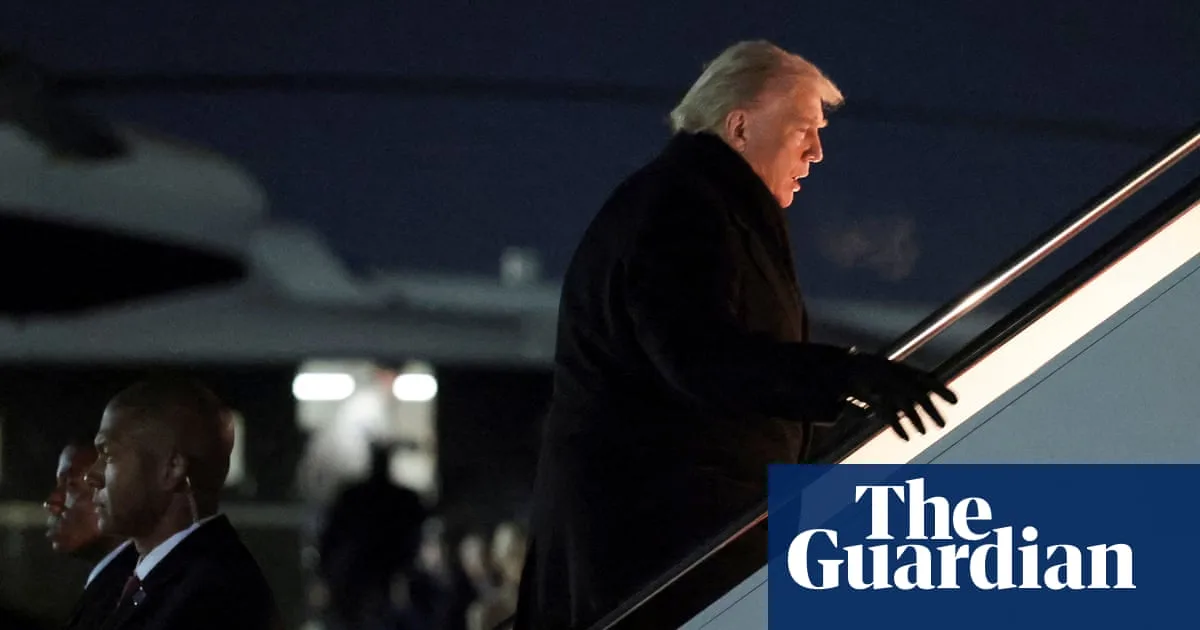
US President Donald Trump's aircraft, Air Force One, was forced to abort its flight to Switzerland and return to Washington DC on Tuesday evening after what officials described as a 'minor electrical issue'. The plane turned back shortly after departure, and Trump transferred to an Air Force C-32, a modified Boeing 757 typically used for domestic trips, to continue his journey to the World Economic Forum in Davos.
White House Press Secretary Karoline Leavitt stated that the decision was made 'out of an abundance of caution' once the crew detected the fault. A White House pool reporter noted that lights in the press cabin flickered off briefly after takeoff, though no further explanation was provided at the time.
The two ageing jets serving as Air Force One have been in service for nearly four decades, with Boeing's replacement efforts facing repeated delays. In 2025, controversy arose when Qatar's ruling family gifted Trump a luxury Boeing 747-8 for the presidential fleet, which is currently being refitted to meet US security standards. Leavitt quipped to reporters that the Qatari jet was sounding like the 'much better' option at that moment.
The unscheduled turnaround was expected to delay Trump's arrival in Davos, where the meeting is overshadowed by his threat of tariffs on European countries over Greenland. Trump told reporters before departing: 'Let's put it this way: it's going to be a very interesting Davos.' Earlier, at a press briefing, he declined to specify how far he would go to acquire Greenland, saying only: 'You'll find out.'
The delegation includes Secretary of State Marco Rubio, Chief of Staff Susie Wiles, Deputy Chief of Staff Stephen Miller, and National Economic Council Director Kevin Hassett. Technical problems on the presidential jet are rare due to meticulous maintenance, though similar incidents have occurred, including a mechanical issue forcing Rubio's plane to return to Washington in February 2025 and an emergency landing by Defence Secretary Pete Hegseth's aircraft in Britain in October 2025 due to a cracked windshield.




