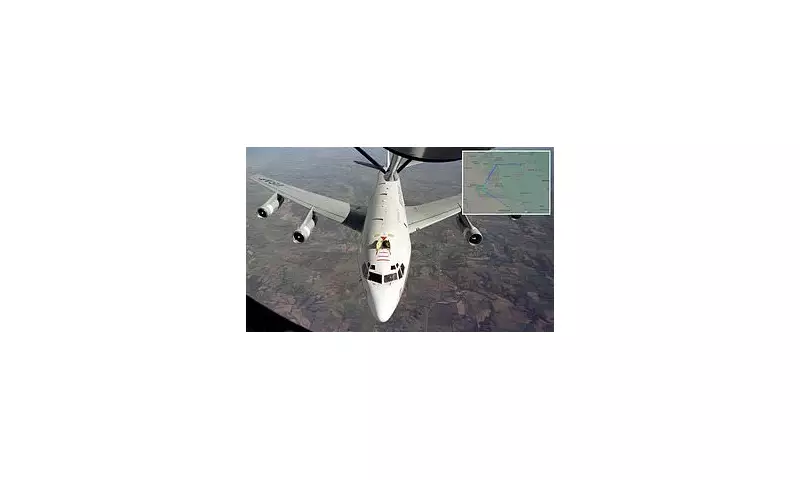
A specialised US Air Force aircraft, known for its role in detecting nuclear activity, was tracked flying across multiple American states on Thursday, sparking intense speculation and concern among online observers. The flight of the Boeing WC-135R Constant Phoenix, colloquially dubbed the 'nuclear sniffer', comes at a diplomatically sensitive moment as a key arms control pact with Russia is set to lapse.
Flight Path and Mission Profile
According to publicly available flight data, the distinctive aircraft took off from its home base in Nebraska. Its mission path included circling over South Dakota and making a loop near Fargo, North Dakota, before continuing to orbit above Rapid City, South Dakota. While such domestic flights are not unusual, its timing has drawn particular attention.
The primary function of the WC-135R is to collect atmospheric samples to detect and identify radioactive debris from nuclear explosions. This capability is crucial for verifying compliance with international arms control treaties and for national security monitoring. The aircraft is uniquely modified with an external atmospheric collection suite, featuring flow-through devices that capture particulates and a compressor system that collects whole-air samples in holding spheres for later laboratory analysis.

A Legacy of Atomic Detection
The Constant Phoenix programme has a long history, dating back to a directive from General Dwight D. Eisenhower on 16 September 1947. The mission was clear: to detect atomic explosions anywhere in the world. A historic early success came in September 1949, when a WB-29 aircraft collected debris confirming the Soviet Union's first atomic test—an event US intelligence had believed was years away.
Over the decades, the fleet evolved through models like the WB-50 to today's WC-135, becoming the sole US Air Force platform dedicated to airborne nuclear air-sampling. These aircraft have operated globally, from the Far East and the Indian Ocean to the polar regions and the coasts of Africa. Notably, a WC-135W monitored radioactive fallout from the 1986 Chernobyl disaster. Today, the fleet continues to support the 1963 Limited Nuclear Test Ban Treaty.
Timing Fuels Treaty Anxiety
The flight quickly became a topic of discussion on social media, with many users linking it to the impending expiration of the New START Treaty with Russia on 5 February. This treaty, signed on 8 April 2010, caps the number of deployed strategic nuclear warheads at 1,550 for each nation.
In September, Russian President Vladimir Putin proposed a one-year extension to adhere to the treaty's limits. US President Donald Trump has not yet given a formal response, leaving Western security analysts divided on the merits of accepting the offer. This uncertainty forms the backdrop to the WC-135R's mission.
US officials have not confirmed the specific reason for Thursday's flight. It is important to note that domestic missions are frequently routine. They often serve purposes such as:
- Crew training and proficiency.
- Calibration of sensitive onboard equipment.
- General background radiation monitoring to establish environmental baselines.
Such flights are common over the Midwestern United States, an area that hosts strategic assets. The Air Force last deployed a WC-135R overseas in 2024 to the Middle East. The crew for the flight typically includes a cockpit team from the 45th Reconnaissance Squadron at Offutt Air Force Base, Nebraska, and equipment operators from Detachment 1 of the Air Force Technical Applications Center, also based at Offutt.
While the sighting of the 'nuclear sniffer' invariably stirs anxiety, especially amid geopolitical tensions, experts caution that many of its missions are standard operational procedures rather than responses to specific international events.