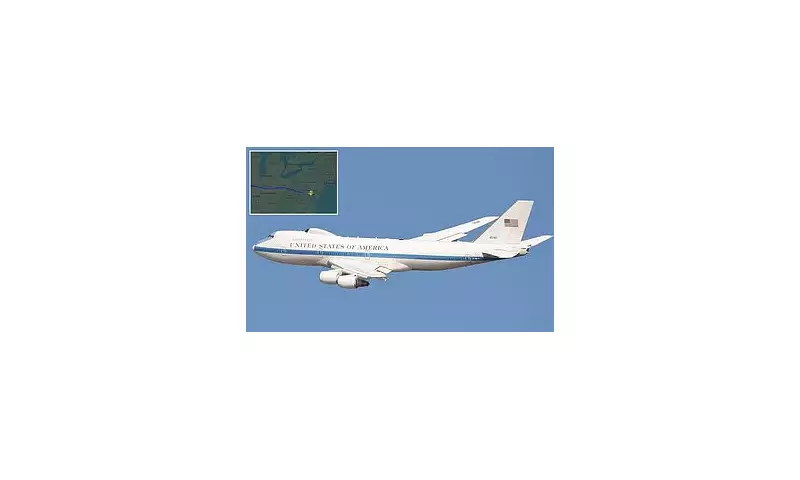
The United States military's highly specialised airborne command post, known as the 'Doomsday Plane', was tracked making a significant flight to the outskirts of Washington DC this week. This movement comes amid a period of escalating international tensions for the Trump administration, following a series of bold actions and stark warnings directed at several nations.
Aircraft Movement and Heightened Readiness
Flight tracking data showed the Boeing E-4B Nightwatch aircraft departing from its primary base at Offutt Air Force Base near Omaha, Nebraska, at approximately 4:50 PM Eastern Time on Tuesday. The aircraft, designed to serve as a survivable flying command centre during a national crisis, flew eastward for nearly three hours before landing at Camp Springs, Maryland, just outside the US capital.
While officials have not confirmed the specific reason for the flight, such movements can indicate routine operations, training exercises, or a state of heightened readiness. The E-4B is built to withstand electromagnetic pulses and coordinate military operations even in the aftermath of a nuclear attack, though it is also used for transporting senior officials.

Context of Global Escalations
The aircraft's deployment coincides with a flurry of aggressive foreign policy moves from the White House. This activity began just days after US forces captured Venezuelan President Nicolás Maduro in a covert operation on Saturday. Maduro and his wife, Cilia Flores, appeared in a New York court on Monday, pleading not guilty to narco-terrorism charges.
In the wake of this mission, President Trump issued stern warnings to other Latin American nations. He targeted Mexico over cartel influence and fentanyl trafficking, Colombia concerning drug production, and Cuba, signalling an expanded US role across the Western Hemisphere.
Simultaneously, the administration has renewed its pursuit of US control over Greenland, citing Arctic national security concerns related to Russia and China. A senior official stated the White House is exploring "a range of options," including a purchase or assuming defence responsibility, and warned that "utilising the US military is always an option." This stance has been firmly rejected by Denmark, Greenland, and European allies.
Broader International Flashpoints
The period of tension extends beyond the Americas. On Wednesday, the US seized a Russian-linked tanker off Europe and another vessel in the Caribbean, intensifying enforcement of the Venezuela oil blockade.
Iran has also emerged as a critical flashpoint, experiencing its largest and most violent anti-regime protests in three years. The unrest, driven by a severe economic crisis and collapsing currency, has left at least 20 people dead. President Trump has threatened to hit Iran "very hard" if its authorities continue their crackdown on demonstrations, now entering a second week.
While the exact purpose of the E-4B Nightwatch's flight remains officially unconfirmed, its timing is conspicuous. The aircraft, a powerful symbol of continuity of government and military command during existential threats, is airborne during a moment where the US administration is actively engaged on multiple contentious fronts across the globe.