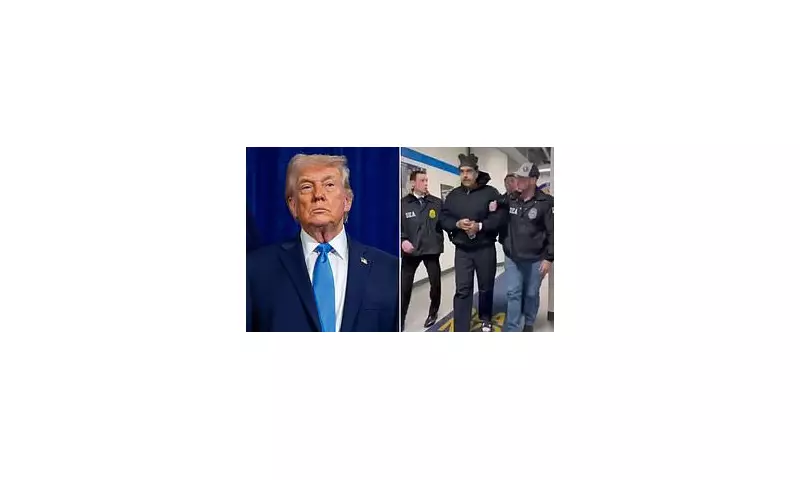
In an unprecedented military operation, United States forces have captured Venezuelan President Nicolás Maduro, spiriting him to New York to face criminal charges while President Donald Trump declares the US will now run the South American nation.
The Dawn Raid and Capture
The dramatic events unfolded in the early hours of Saturday morning in Caracas. Around 2am local time, residents were woken by explosions and the sound of military helicopters as US air strikes pounded sites including a major military base and an airbase. The attack lasted nearly an hour.
Supported by 150 aircraft, US commandos launched a lightning raid, seizing Maduro and his wife, Cilia, from their residence. According to top US military officer General Dan Caine, the operation was based on months of intelligence into Maduro's daily habits. The couple "gave up" without a struggle, and there was no loss of US life, though Trump later told the New York Post that "many" Cubans in Maduro's security detail were killed.

A US government plane transported the captured leader to a military base, and he was then flown by helicopter to New York City. The White House later posted video on X showing the 63-year-old leftist, handcuffed and wearing sandals, being escorted through a US Drug Enforcement Administration facility. "Good night, happy new year," Maduro is heard saying in English.
Trump's Plan for Venezuela
Speaking from Mar-a-Lago on Saturday afternoon, flanked by cabinet members, President Trump made a series of startling announcements. He confirmed that Maduro and his wife would be arraigned on drug trafficking and weapons charges. More significantly, he declared that the United States would run Venezuela following the capture.
"We're going to stay until such time as the proper transition can take place," Trump stated, indicating a long-term US involvement. He said he was already "designating people" from his cabinet to be in charge in Venezuela and indicated US troops could be deployed, remarking that Washington is "not afraid of boots on the ground."
In a move that surprised observers, Trump appeared to reject the country's US-backed opposition, led by Maria Corina Machado, from taking power. He claimed Machado, who won last year's Nobel Peace Prize, lacks "support or respect" in Venezuela. Instead, he suggested he could work with Maduro's vice president, Delcy Rodriguez, saying "she's essentially willing to do what we think is necessary to make Venezuela great again."
Rodriguez swiftly rejected this, demanding Maduro's release and vowing to "defend" the country. Late Saturday, Venezuela's Supreme Court ordered her to assume presidential powers "in an acting capacity."
International Condemnation and Domestic Uncertainty
The operation has triggered a major international crisis. China, a key ally of Venezuela, "strongly condemned" the US action and called for Maduro's immediate release. Its Foreign Affairs Ministry stated the move violated international law and the UN Charter.
France warned that a solution could not "be imposed from outside," while UN Secretary-General Antonio Guterres said he was "deeply concerned that the rules of international law have not been respected." At Venezuela's request, the UN Security Council will meet on Monday to discuss the crisis.
Within Venezuela, the situation remains highly volatile. Following the raid, Caracas fell eerily quiet, with police stationed outside public buildings. The US and numerous European governments had long refused to recognise Maduro's legitimacy, accusing him of stealing elections in 2018 and 2024.
Trump offered several justifications for the aggressive policy, citing illegal migration, narcotics trafficking, and, notably, Venezuela's vast oil reserves. "We're going to have our very large United States oil companies... go in, spend billions of dollars, fix the badly broken infrastructure," he said. "We'll be selling large amounts of oil."
Domestically in the US, several members of Congress quickly questioned the legality of the operation, while Trump's key ally, House Speaker Mike Johnson, said it was "justified." As the world reacts, the future of Venezuela hangs in the balance, with the US now committing to an open-ended and deeply controversial administration of a sovereign nation.