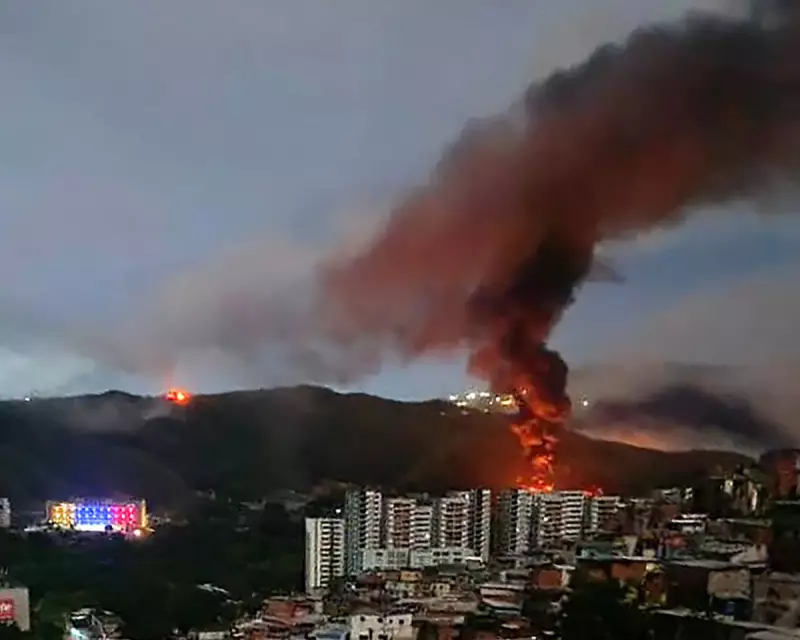
Venezuela's political landscape was violently reshaped on Saturday as United States military forces conducted airstrikes on the capital, Caracas, setting the country's largest military complex ablaze and culminating in the capture of President Nicolás Maduro.
From Political Theatre to Military Reality
For decades, the spectre of a US invasion was a central pillar of Venezuelan state rhetoric. The late leader Hugo Chávez, who ruled from 1999 until his death in 2013, repeatedly warned his citizens of impending American aggression. He spun tales of CIA saboteurs, submarine incursions, and even suggested the US possessed technology to induce cancer. This narrative, largely viewed as theatrical propaganda to justify authoritarian control and rally anti-imperialist sentiment, became a defining feature of Chavismo.
On Saturday, that long-held "fever dream" became a stark reality. Without a UN mandate or explicit congressional approval, US forces bombed targets in Caracas. The operation, which included cutting the city's power supply, successfully apprehended Maduro and his wife, First Lady Cilia Flores. The action represents the most direct US military intervention in Latin America in decades, drawing immediate parallels to the 1983 invasion of Grenada and the 1989 operation in Panama.

Trump's 'Donroe Doctrine' and a Bizarre Circularity
Watching the operation from his Mar-a-Lago resort alongside CIA Director John Ratcliffe, former US President Donald Trump declared a monumental victory. He praised the mission as "one of the most stunning, effective, and powerful displays of American military might and competence in American history." In a move rich with historical irony, Trump announced a new "Donroe doctrine" of regional dominance, a clear echo of the 19th-century Monroe Doctrine that Chávez frequently denounced.
The twist is profoundly surreal. The populist, norm-shattering style of Trump mirrors the political showmanship of Chávez himself. Both leaders mastered the art of polarising publics and dominating media narratives. Now, Trump has executed the very invasion Chávez so often prophesied, creating a bizarre circularity in history. The 2002 coup attempt against Chávez, which saw tacit US support, ultimately bolstered his grip on power. This latest intervention, however, has physically removed his successor.
Uncertain Future and a Nation's Dread
Trump outlined an ambitious and controversial plan for Venezuela's future, stating the US would run the country for an indefinite period to ensure a "safe, proper and judicious transition." He explicitly linked this to US oil interests, saying American companies would "spend billions of dollars" to fix the nation's broken oil infrastructure. However, he clouded the political picture by suggesting cooperation with Delcy Rodríguez, Maduro's vice-president, who has reportedly been sworn in as president.
For the Venezuelan people, who have endured years of economic collapse and authoritarian rule, the aftermath swings between hope and profound dread. Millions have fled the country during Maduro's tenure. The question now is whether this dramatic intervention marks the end of a national nightmare or the beginning of a new, uncertain chapter under direct foreign oversight. As the smoke clears over the Caracas military complex, the world watches to see if Venezuela has awakened from a fever dream or descended deeper into one.