Ukraine's Military Transformation: How New Corps Challenge Soviet Legacy
When a Ukrainian agricultural tycoon established a small volunteer unit of just thirty individuals during the initial phase of Russia's invasion, survival was uncertain. Yet, both the founder and his fledgling force endured, evolving into a formidable 40,000-strong corps now recognized as one of Ukraine's most effective fighting formations within its official defense forces.
"Ukraine needs to have an effective modern army. And this is our number one guarantee of the country's security," stated Vsevolod Kozhemyako, owner of a major agricultural conglomerate and currently an adviser to the Commander of the Khartiia Corps.
Soviet Legacy Versus New Military Model
Following the collapse of the Soviet Union, Ukraine inherited a substantial military and arsenal. However, by 2014, Russia's annexation of Crimea and the ensuing armed conflict in eastern Ukraine revealed critical weaknesses stemming from underinvestment, corruption, and a lack of clear strategic direction. This prompted an influx of volunteers and long-overdue military reforms.

While these changes aided Ukraine in withstanding the 2022 invasion, prolonged warfare has seen some deep-seated issues resurface. Rigid top-down leadership, excessive bureaucracy, and a culture where fear of punishment often suppresses bad news have reasserted themselves, impacting battlefield outcomes.
From the beginning, Kozhemyako insisted his unit would chart a different course. As an active military member since 2014, surrounded by veterans, he understood the regular army's shortcomings intimately.
"They didn't want to join the post-Soviet army, but they wanted to fight," Kozhemyako recalled, noting many volunteers were civilians with business backgrounds who brought a distinct leadership mindset focused on initiative.
Trust and Technology as New Tactical Foundations
The unit's approach began with studying and applying U.S. Army planning methods, blending them with battlefield experience and adapting as the war evolved. Western protocols like Troop Leading Procedures (TLP) and After Action Reviews (AAR) were introduced, refined by in-house experts.
TLP enables lower-level units to plan operations swiftly, crucial for exploiting narrow windows of opportunity. AAR pushes soldiers to analyze what happened, why, and how to improve, a process the corps applies rigorously to its fast-evolving use of technology.
The Khartiia Corps' focus on rapidly advancing technologies has garnered international attention. In an article for Military Review, the U.S. Army's professional journal, Maj. Gen. Curtis Taylor highlighted Khartiia's December 2024 drone assault near Kharkiv as a landmark—the first all-robot attack on Russian positions. He argued this serves as a call for the U.S. Army to rethink how its armored formations must adapt to survive modern battlefields.
This technology is now integral to daily operations. A 23-year-old platoon commander transferred from a regular unit to Khartiia was put in charge of ground robotic systems used routinely for supply delivery and evacuation. He noted a stark contrast in culture, with less emphasis on rigid formalities like strict dress codes and repetitive non-combat routines.
"People understand why we are here, and they don't overload us with unnecessary tasks," he said, having paced a military position in blue plush house slippers. He also highlighted a different relationship with commanders, contrasting Khartiia's trust-based environment with the rigid hierarchy and fear of punishment he previously experienced.
Business Tools Yield Battlefield Results
The tangible outcomes are evident on the battlefield. In December 2025, the Khartiia Corps led a counterattack in the Kupiansk direction, liberating several villages north of the city and advancing to the Oskil River. The Institute for the Study of War noted that seizing Kupiansk had been a Russian priority since mid-2025, yet despite months of effort, Russian forces failed to make significant gains.

The Washington-based think tank assessed in December that this operation demonstrated Ukrainian forces remain capable of "conducting successful counterattacks and making tactically significant gains, particularly when Russian forces are overstretched."
Relying largely on its own recruitment and fundraising, the corps has built a professional HR system and a strong brand, actively utilizing YouTube and social media, partnering with public figures, and facilitating online donations.
A Ukrainian military officer involved in public outreach for a Ground Forces unit stated that the Third Army Corps and Khartiia have become trendsetters, with others actively studying their campaigns when building their own. These corps were among the first to develop distinct brands, now critical as the army faces constant recruitment needs.
"The approaches that work in the commercial sphere translate perfectly here—only you are competing not for profit, but for people, equipment, and the attention of volunteers," he explained.
Spreading the Innovative Model
Entering one of Khartiia's underground command posts feels more like stepping into a gaming room than a military hub. Large screens stacked wall-to-wall display real-time reconnaissance footage from the front line in Ukraine's Kharkiv region. Overseeing operations is a former bodybuilding coach who rose from soldier to senior officer, dressed in a Khartiia hoodie with an energy drink by his keyboard.
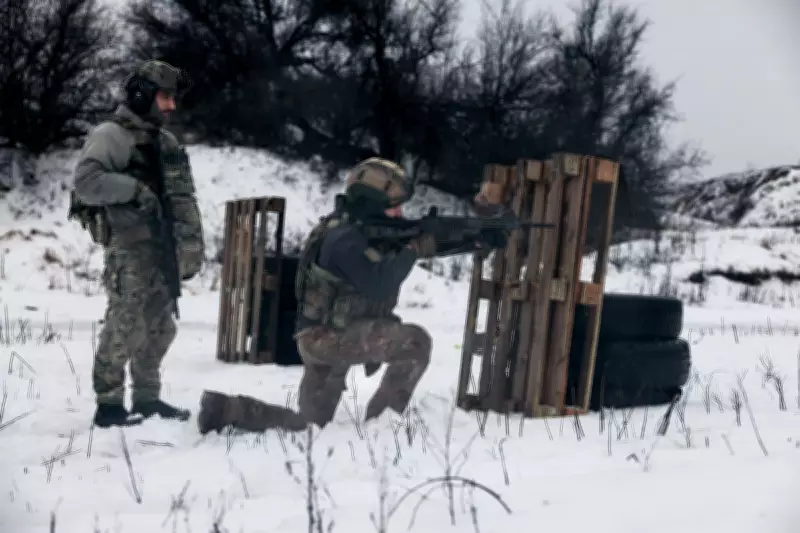
"One of our secrets is that we don't spare people during training—we train them constantly," he said. "But during combat, it's the opposite. People come first. We don't save drones or equipment at the expense of our people."
This philosophy is now being disseminated through direct alliances with like-minded formations. Khartiia and the 3rd Army Corps recently launched a joint training initiative, sharing resources and expertise to build a common fighting approach.
For commanders, who are also neighbors on the front lines, the motivation is practical. After months of tactical exchanges, both units identified the same critical vulnerability in the broader army: an urgent need to overhaul basic combat training for soldiers, sergeants, and junior officers.
Ihor Obolienskyi, commander of the Khartiia Corps, estimated that about 300,000 troops are currently deployed along the front line, with the two corps accounting for roughly 80,000—sufficient, he believes, to drive meaningful change within the military, despite reform challenges in what he described as an inherently inert system.
Commanders from other units have already approached the corps to learn from their model, indicating growing demand for change within the army. Yet, it remains uncertain if senior command is prepared to fully abandon its Soviet legacy.
"We want to give a tool to the General Staff," said Andrii Biletskyi, commander of the 3rd Army Corps, during a joint briefing. "Whether they accept it or not—that is their decision."