
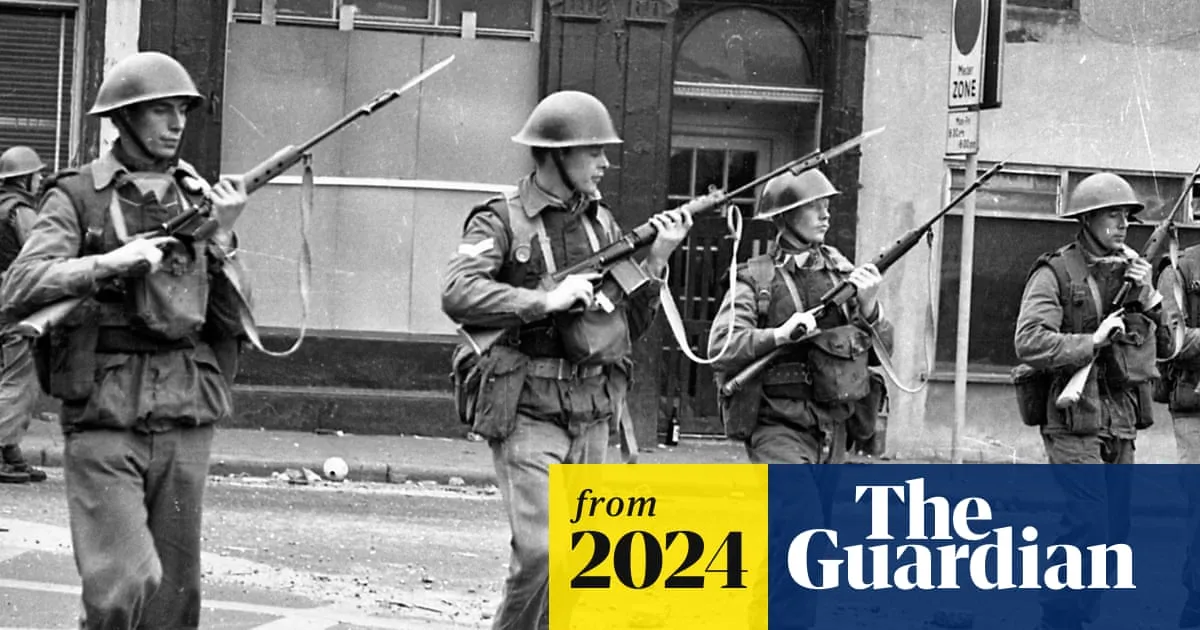
On 14 August 1969, the British government deployed troops on the streets of Northern Ireland to restore public order after weeks of violent sectarian rioting. Open warfare broke out between the Protestant Shankill and the Roman Catholic Falls Road in Belfast early today, with machine gun fire heard in Divit Street at the corner of the Falls Road. In Armagh, a man was shot dead during a riot following a civil rights meeting, and two other men were killed in shooting incidents in Belfast.
In Whitehall, it is hoped that the need for British troops may be confined to Londonderry, with withdrawal as soon as order is restored. An Inspector of Constabulary, Mr J McKay, is being sent from the Home Office to advise General Sir Ian Freeland, the General Officer Commanding in Northern Ireland, who is responsible directly to Westminster.
Reports that the soldiers have no bullets in their weapons do not mean that ammunition is not available if required. As an Ulster headquarters spokesman pointed out: “By standard operational procedure, ammunition is always present when weapons are used.” This likely means that ammunition is carried in boxes in trucks but will not be issued unless the situation deteriorates; troops would only fire in the last resort.
The 300 men of the Prince of Wales’s Own Regiment who moved into Londonderry last night will be firmly under the control of Whitehall. Their deployment will be on orders from the Ministry of Defence, though it may result from requests from the Northern Ireland government. The troops moved into the city centre within moments of the announcement that their help had been requested by the Inspector-General of the Royal Ulster Constabulary. In full combat kit and armed with rifles and submachine guns, they swept down from the Royal Navy barracks in Londonderry, where they had been held in readiness during 48 hours of rioting.
U Thant, the Secretary-General, has told the Irish delegation to the United Nations that there is nothing he can do to help solve the conflict, informed sources said. The biggest question for the Westminster and Ulster governments is how long British troops will stay in Ulster. Last night it was stressed that 300 men were in a limited place for a limited time doing a limited job. However, Whitehall may soon have to consider what new links with Stormont will be necessary if troops are used for longer than needed to deal with the immediate conflict. No one is seriously thinking about the suspension of the government at Stormont, followed by direct rule from Westminster—a morass into which few British politicians would wish to venture.




