Former US President Donald Trump's stark warning that the NATO alliance "need us much more than we need them" has ignited a profound and difficult debate across Europe. His comments, made to reporters aboard Air Force One, force a critical examination: what would the world's most powerful military alliance look like without the steadfast support of the United States?
The American Backbone of NATO
Trump's remarks, delivered as he reiterated his interest in acquiring Greenland for national security reasons, directly challenge the foundation of the transatlantic partnership. He questioned whether NATO allies would be there for the US if needed, stating, "I'm not sure they would." This has revived deep-seated anxieties that America's commitment to the collective defence clause, Article 5, is no longer guaranteed.
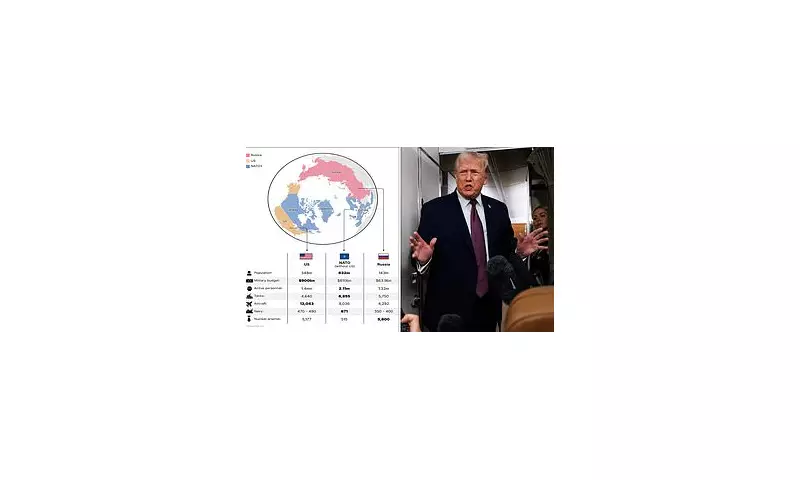
The United States has long been the undeniable backbone of NATO. In 2025, the combined military spending of all NATO states reached approximately 1.5 trillion dollars. Crucially, the US alone accounted for over 900 billion dollars of that colossal total. While NATO members had a previous target of spending 2% of GDP on defence—a figure Trump long argued was too low—a new, more ambitious goal of 5% by 2035 was agreed upon at last year's summit.

In 2024, the US spent around 3.38% of its GDP on defence, surpassed within the alliance only by Estonia (3.43%) and Poland (4.12%). The raw military power of the alliance, with the US included, overwhelmingly dominates potential adversaries like Russia. NATO fields around 3.5 million active personnel against Russia's 1.32 million, and possesses over 22,000 aircraft and 1,143 military ships compared to Russia's 4,292 and 400 respectively.
Europe's Strengths and Critical Gaps
On paper, a Europe without the United States would not be entirely defenceless. Excluding America, the other 31 NATO members still control over a million troops, advanced weaponry, and significant industrial capacity. Nations like the UK and France maintain independent nuclear deterrents, with the combined arsenals of the US, UK, and France totalling 5,692 warheads, slightly above Russia's estimated 5,600.
Several European powers possess formidable hardware. While Russia operates a single ageing aircraft carrier, the UK commands two modern carriers capable of launching F-35B stealth fighters. France, Italy, and Spain also operate aircraft carriers or amphibious assault ships. European NATO members collectively operate around 2,000 fighter and ground attack jets, including advanced F-35s.
However, military experts warn that Europe's critical deficiency is not in manpower or individual platforms, but in the complex, enabling capabilities that allow modern high-intensity warfare to be fought and sustained. According to analysis, Europe remains heavily dependent on the US for:
- Intelligence, surveillance, and reconnaissance (ISR)
- Strategic airlift and aerial refuelling
- Integrated air and missile defence
- Long-range precision strike
- Space and cyber capabilities
Retired US Major General Gordon 'Skip' Davis emphasised that these assets are essential for commanding large-scale operations. "What the US brings is capabilities like strategic command and control systems," Davis said, warning that without them, European forces would struggle in a prolonged conflict.
Structural Dependencies and the Ukraine Test
The dependency is also deeply embedded in NATO's command structure. Its most senior operational commands, including Supreme Allied Commander Europe (SACEUR), are all led by US officers. "I don't think that NATO could operate without US commanders and staff. That would be extremely difficult," Davis cautioned.

The war in Ukraine has exposed further vulnerabilities in European defence, particularly in industrial capacity and ammunition stockpiles. The EU failed to meet its target of supplying Ukraine with one million artillery shells by spring 2024, while the US doubled its monthly production of 155mm shells. Russia, meanwhile, is reportedly producing around three million artillery rounds annually.
US aid has been central to Ukraine's war effort, from Javelin missiles and HIMARS rocket systems to Patriot air defences. A pause in American aid at the start of March 2025 raised serious doubts about whether European allies could compensate if US support was withdrawn permanently.
As NATO chief Mark Rutte stated this week, the alliance is working on bolstering Arctic security. Yet, Trump's rhetoric underscores a chilling reality: if Europe fails to rearm rapidly and develop its own strategic enablers while Russia rebuilds its forces, the continental balance of power could shift decisively. The question posed by Trump's comments is no longer hypothetical, but an urgent strategic imperative for European capitals.