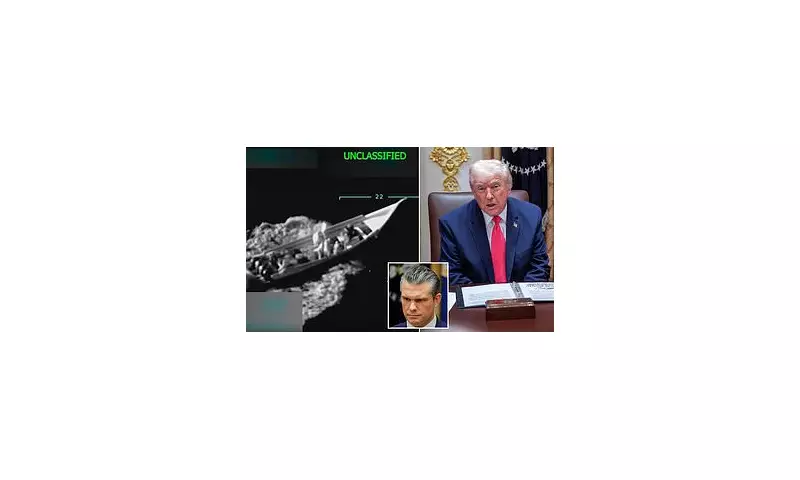
President Donald Trump and his Secretary for the Department of War, Pete Hegseth, have publicly commended the military commander responsible for authorising a series of controversial lethal strikes on Venezuelan vessels suspected of drug trafficking. The defence comes amidst a storm of critical media coverage and scrutiny from Congress over the administration's aggressive tactics in the Caribbean.
Strikes and Scrutiny: The White House Position
The administration has confirmed authorising over 20 separate strikes on boats allegedly used for drug running, operations which have resulted in more than 80 fatalities. During a Cabinet meeting on Tuesday, President Trump was unequivocal when questioned by reporters about a September mission that required multiple airstrikes. "We're taking those son of a b****es out," he declared, framing the actions as a necessary response to the flow of narcotics into the United States.
Trump placed blame on his predecessor, Joe Biden, alleging he had allowed both migrants and drugs to enter the country "totally unvetted, totally unchecked." He further expanded the potential scope of the campaign, stating, "I want those boats taken out, and if we have to, we will attack on land also." The Republican leader explicitly mentioned Colombia's rampant cocaine production as another potential target, asserting that "anybody that's doing that and selling it into our country is subject to attack."

The 'War Crime' Allegations and Military Justification
Secretary Hegseth, fielding detailed questions, praised Admiral Frank Bradley, the commanding officer who ordered a follow-up strike in September. Hegseth asserted the Admiral was "well within his lane" and lauded the "deliberative... rigorous" process undertaken by military professionals to verify the boats' links to terrorism.
However, Democratic lawmakers in Congress have likened the tactics, particularly the secondary strike, to a potential 'war crime'. Under international law, targeting combatants who are wounded or hors de combat is prohibited. A recent Washington Post report, unverified by the Daily Mail, claimed Hegseth gave verbal orders to ensure there were no survivors—an allegation the White House vehemently denies.
White House Press Secretary Karoline Leavitt stated on Monday that "Admiral Bradley worked well within his authority and the law." Hegseth framed the policy in stark terms, asking reporters, "How do you treat al Qaeda and ISIS? Do you arrest them and treat them... Or you end the problem directly by taking a lethal, kinetic approach?"
The Broader Context: Fentanyl, Cocaine, and Military Buildup
The administration justifies the strikes as a defence of American citizens, pointing to the thousands of overdose deaths linked to drugs like fentanyl and cocaine. Trump has cited estimates suggesting a quarter of a million Americans have died from fentanyl-related overdoses since 2021.
Yet, analysts note a key distinction: while Venezuela is a major source of cocaine, most fentanyl entering the US originates in Mexico. "Fentanyl is not coming out of Venezuela. Fentanyl comes from Mexico," said Christopher Hernandez-Roy of the Center for Strategic and International Studies.
Concurrently, the US has significantly bolstered its military presence in the region, deploying nearly a dozen warships, a submarine, over 70 aircraft, and 15,000 soldiers to the Caribbean in recent months. In contrast, Venezuelan President Nicolas Maduro has been seen at rallies dancing to anti-war songs, signalling a desire to avoid open conflict with the United States.