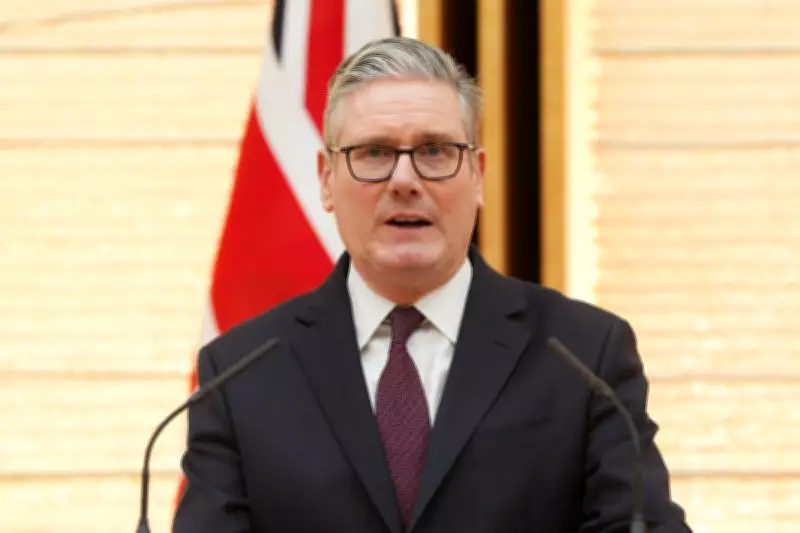
Prime Minister Sir Keir Starmer has explicitly outlined his ambition for the United Kingdom to forge stronger defence and security links with European partners. This strategic pivot comes as Cabinet Office minister Nick Thomas-Symonds prepares to engage in the latest EU-UK Partnership Council meeting scheduled for the coming week.
Focus on European Security Collaboration
During his recent diplomatic visit to East Asia, Sir Keir was questioned on the potential for Britain to participate in the European Union's substantial Security Action for Europe (SAFE) rearmament initiative. This fund, valued at approximately 150 billion euros (£130 billion), represents a significant continental effort to bolster collective defence capabilities.
"Europe, including the UK, needs to do more on security and defence," the Prime Minister asserted to accompanying journalists. "That's an argument I've been making for many months now with European leaders. We've got to step up and do more."

Evaluating the SAFE Fund and Broader Cooperation
While previous negotiations regarding UK accession to the SAFE programme reportedly stalled late last year over cost considerations—with French officials denying allegations they insisted on a high price tag—Sir Keir indicated a renewed willingness to explore entry.
"I do think on spend, capability and co-operation we need to do more together," he stated. "I've made the argument and that should require us to look at schemes like SAFE and others to see whether there is a way in which we can work more closely together."
He emphasised that closer collaboration, whether through SAFE or alternative frameworks, constitutes prudent policy for "Europe in the widest sense of the word – which is the EU, plus other European countries."
Context of Upcoming Trade Negotiations
The Prime Minister's comments on defence precede critical trade discussions between the UK and the European Union. The forthcoming Partnership Council will focus on ongoing efforts to deepen ties across various sectors following the UK's departure from the bloc.
Sir Keir took the opportunity to criticise the execution of Brexit under the previous administration, labelling their deal as "botched." He highlighted Labour's active negotiations to establish new arrangements, particularly concerning food and agriculture, which he contends will ultimately "lead to lower prices in our supermarkets."
Rejecting Comparisons with Reform and Nigel Farage
When pressed by reporters on whether his pro-European stance signalled a retreat from Brexit principles designed to differentiate his government from Reform Party figure Nigel Farage, the Prime Minister offered a robust rebuttal.
He catalogued a series of unfulfilled promises associated with the Leave campaign, noting that the famed £350 million weekly NHS boost never materialised, trading red tape with Europe persisted, and legal migration "quadrupled under the Boris wave."
"So I wouldn't listen too much to what Nigel Farage has to say about this," Sir Keir concluded, framing his government's approach as a pragmatic correction to past failures rather than an ideological reversal.
The Prime Minister's unambiguous advocacy for enhanced European defence integration, set against the backdrop of imminent trade talks, signals a deliberate shift in the UK's post-Brexit foreign policy orientation. It underscores a commitment to operational cooperation with EU neighbours while navigating the complex legacy of the withdrawal agreement.