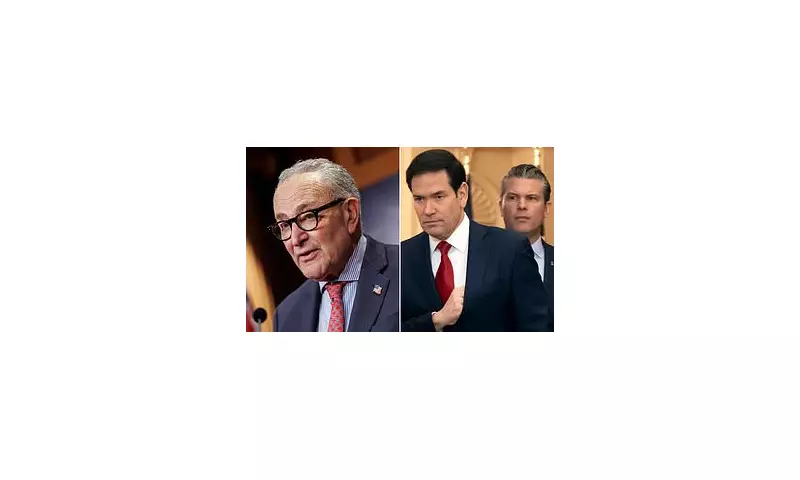
Senior officials from the Trump administration are set to provide a crucial briefing to US senators this Tuesday, addressing the controversial military strikes conducted against suspected Venezuelan drug smuggling vessels in September. The session, which will include details of a now-notorious 'double strike', follows intense pressure from Democratic lawmakers demanding accountability.
Mounting Pressure for Congressional Oversight
The briefing, to be delivered by Secretary of State Marco Rubio and Secretary of War Pete Hegseth, comes after a sustained campaign led by Senate Minority Leader Chuck Schumer. Schumer has publicly condemned the operations, labelling them as "rogue and reckless actions in the Caribbean" and insisting that "The American people deserve oversight. We intend to deliver it."
While Rubio met with senior Senate leaders last week, he notably did not present video evidence of the September 2nd incident. This footage includes the second attack, which some legal experts and politicians argue may have been unlawful. The upcoming briefing is expected to address these concerns directly.

Divisions on Legality and Future Policy
The strikes have exposed a sharp partisan divide. Republican Senator Tom Cotton, a key Trump ally who chairs the Senate Intelligence Committee, has voiced strong support for the military action. After viewing the video, Cotton stated he would have made the same decision as Pentagon leaders, arguing "Any boat loaded with drugs that is crewed by associates and members of foreign terrorist organizations... is a valid target." He added, "I'm not just comfortable with it, I want to continue it."
In stark contrast, top Democrats have expressed profound alarm. Representative Jim Himes, a senior Democrat on the House Intelligence Committee, described the double strike video as "profoundly shaking", highlighting its depiction of deliberately targeting survivors. Adam Smith, Chair of the House Armed Services Committee, noted the two survivors of the initial strike were not in a position to continue fighting before the second attack hit them.
War Powers Resolutions and a Looming Deadline
In response to the escalating situation, War Powers resolutions have been introduced in both chambers of Congress. These measures aim to prevent the administration from engaging in further conflict with Venezuela without explicit congressional authorisation. A House resolution, backed by a bipartisan group including Democrats Jim McGovern and Joaquin Castro alongside Republican Thomas Massie, could be voted on as early as Tuesday afternoon.
The lawmakers behind the resolution argue the administration has neither sought authorisation for the use of military force against Venezuela nor offered a credible justification for the unauthorised strikes. Crucially, the Trump administration notified Congress of the conflict in early October, triggering a 60-day clock for formal approval under the War Powers Act. That deadline has now expired.
The operations, which the US government states targeted drug trafficking, have resulted in significant casualties. Reports indicate at least 95 people have been killed across 25 strikes on 26 alleged drug boats. However, the administration has faced criticism for not providing evidence of the targets' activities and for failing to explain why alternative measures—such as interception, investigation, or prosecution—were not pursued instead of lethal force.