
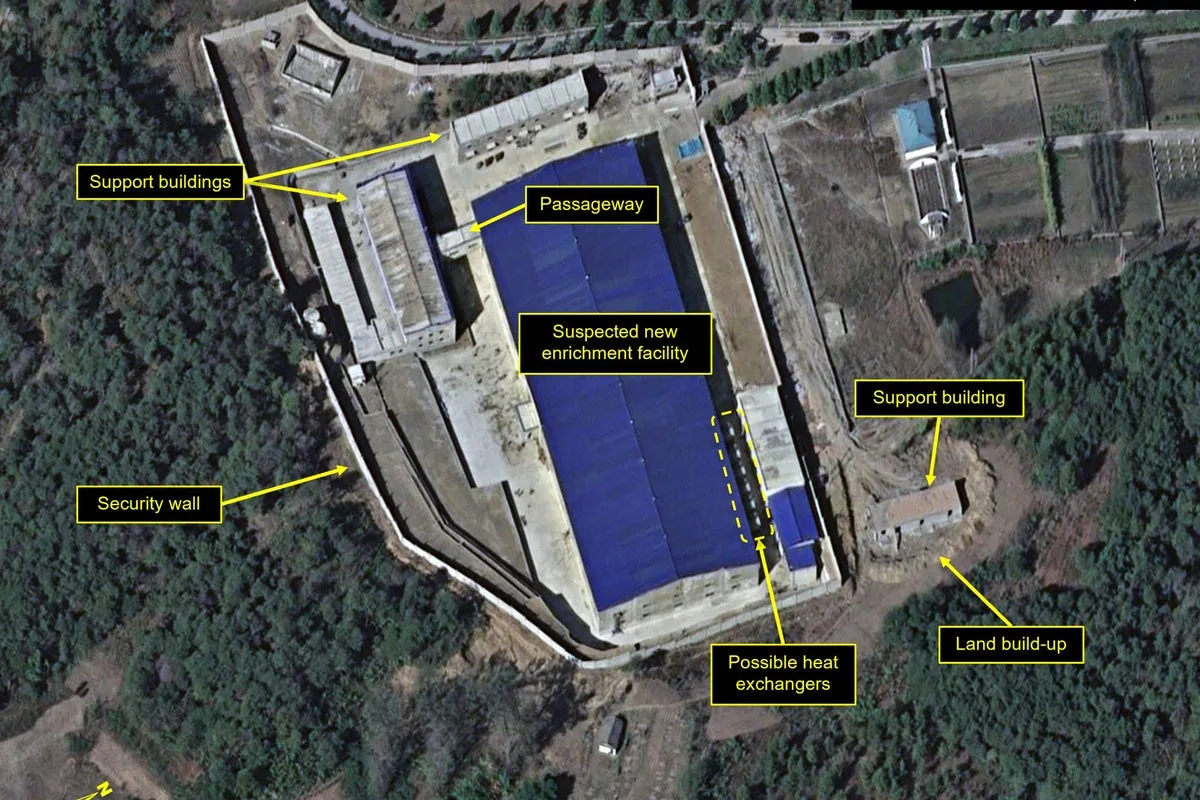
New satellite imagery suggests North Korea is building a new uranium enrichment plant at one of its nuclear sites, part of Kim Jong Un’s 2025 plan to “exponentially” bolster the country's nuclear arsenal.
The images, taken in October and November and analysed by the Washington-based monitoring group 38 North, indicate a “continuation of modernisation and expansion efforts throughout” the Yongbyon Nuclear Scientific Research Centre, experts said. The facility is North Korea’s most important site for producing plutonium and enriched uranium – the two main materials used to make nuclear weapons.
The analysis of the pictures shows that Pyongyang is likely building a large, heavily secured compound northeast of the site’s radiochemical laboratory. The structure – a two-storey building with a central hall measuring roughly 120m by 47m – closely resembles the design and footprint of Kangson, another suspected covert enrichment plant long believed to support the North’s nuclear weapons programme, according to a report by 38 North.
The new facility is growing “most active since the start of 2025”, with six possible heat exchangers recently appearing on the building’s southeast side. The exchangers are typically used to cool centrifuges and maintain the stable temperatures required for uranium enrichment. Analysts say the installation of these units suggests that interior work is well underway, even as support buildings and connecting corridors continue to take shape around the compound.
Satellite images also show a rapid expansion of radioactive-waste storage near Yongbyon’s Old Waste Site. A new semi-buried concrete facility with nine roof hatches appears covered with earth, and fresh excavation nearby suggests another vault, the report notes.
The latest development at the facility is in line with Mr Kim’s instruction earlier this year to accelerate nuclear material production. During visits to weapons-related institutes in January, he described 2025 as a “crucial year” for “bolstering up the nuclear forces” and called for “overfulfilling” plans for weapons-grade output.




