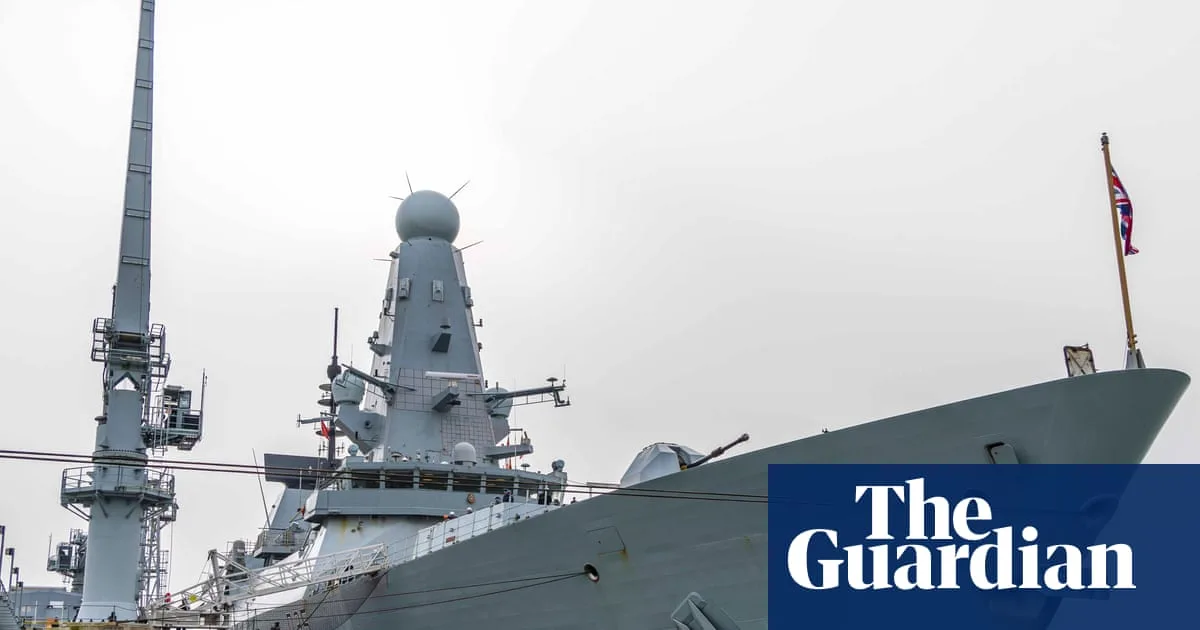
For centuries, the distinctive silhouette of a Royal Navy warship appearing on the horizon has served as a powerful symbol to Britons across the globe that order and stability were imminent. From Admiral Nelson's legendary triumphs against Revolutionary and Napoleonic France, through the West Africa Squadron's groundbreaking anti-slavery patrols in the 19th century, to the Dunkirk evacuation and contemporary disaster relief missions in Sierra Leone and Lebanon, Britain's international influence and reputation were fundamentally constructed upon its maritime supremacy.
A Symbol of Decline Rather Than Strength
However, when HMS Dragon finally becomes visible off the Cypriot coastline, arriving alone a full fortnight after a solitary Iranian drone successfully breached RAF defenses and struck the Akrotiri base on March 2, there will be no welcoming cheers of relief. Instead, due to what many perceive as the staggering incompetence of Sir Keir Starmer's government, the vessel's arrival will only reinforce a growing perception among local residents that Britain is a nation in palpable decline.
'I believe more people are now concluding that the British Army, the Navy, and the RAF are not the organized military forces they once imagined,' Tasos Kosteas, head of the Cyprus Peace Council, stated during an interview conducted outside the gates of RAF Akrotiri. 'People's initial impression of the British was that they were exceptionally organized and prepared to confront such incidents directly.'
'But now – and I say this as someone with many British friends – I suspect perhaps Britain is not genuinely prepared for challenges like this. It is no longer a great country in the same way. They appear unprepared for such provocations,' Kosteas added.
Local Sentiment Turns Against British Presence
The 60-year-old Cypriot activist has advocated for the closure of both RAF Akrotiri and the Dhekelia Cantonment, its companion Sovereign Base Area (SBA), throughout his entire adult life, having served on the peace council for four decades. For years, the council has argued that since Cyprus gained independence from the United Kingdom in 1960, these military bases represent an unwelcome colonial remnant that primarily brings trouble rather than security. Now, Kosteas detects a significant shift in public opinion.
'We possess the moral support of the majority of the Cypriot population,' he explained. 'We have concrete evidence that the British military bases in Cyprus constitute a genuine danger.'
He is not alone in this assessment. 'What was it Trump famously said – "We don't need your battleship"?' remarked Andreas Philis, a 74-year-old retired technician from the Cypriot army, while playing cards at a local cafe. He continued: 'England used to be very capable. But now England is diminishing – you seem uncertain about how to respond.'
'It's not particularly impressive, is it? You maintain the air base – it belongs to you, yet you wait for Greece, Italy, and France to protect your own air base,' Philis observed pointedly.
Projecting Weakness in a Critical Region
Over the preceding two weeks, the British government has projected nothing but weakness to the Cypriot people. After initially refusing United States permission to utilize British bases for joint Israeli strikes against Iran on February 28, Prime Minister Starmer hesitated and then reversed course, allowing their use for 'defensive' strikes the following day. Then, at 12:03 AM local time on March 2, a single Iranian Shahed drone launched from Lebanon completed the 30-minute, 100-mile journey across the Mediterranean Sea undetected and struck RAF Akrotiri on the southern peninsula.
The failure to detect the drone on radar necessitated the precautionary evacuation of nearly all 1,100 residents of Akrotiri. There was not a single Royal Navy vessel on standby to provide relief and reassurance to the Cypriot population. Instead, it was Greece, a comparatively smaller military power, whose two warships arrived first within 48 hours.
International Humiliation and Delayed Response
Britain's humiliation continued unabated. While HMS Dragon remained in dry dock at Portsmouth, a French frigate and subsequently the aircraft carrier Charles de Gaulle arrived in the region. Spain dispatched both a frigate and a supply ship. Even Italian naval forces entered Cypriot waters on Wednesday – the day after HMS Dragon finally commenced its voyage.
French President Emmanuel Macron capitalized on Britain's embarrassment, embracing Cypriot President Nikos Christodoulides in Paphos and assuring the Cypriot people they could 'count on France.' The implicit message was unmistakable – you can no longer rely on Britain. 'It hurt somewhat,' admitted British-Cypriot Christine Wilson, 46, regarding the drone strike and the government's sluggish response.
'Fortunately, nobody was injured, but our reputation...' she added, her gaze dropping to her shoes.
Historical Context and Contemporary Insecurity
Following the Greek Cypriot nationalist insurgency against British rule, a treaty was established in 1960 that granted Cyprus independence while stipulating that the SBAs of Akrotiri and Dhekelia must remain British Overseas Territory. For numerous Cypriots, from that moment forward, the SBAs were regarded as an offensive colonial legacy, with tens of thousands regularly protesting at the gates.
However, when Turkey invaded northern Cyprus in 1974, for many residents, the bases suddenly transformed into a sanctuary. 'People flocked there seeking security, believing Turkey would not attack the bases,' explained Giorgos Konstantinos, deputy mayor of Akrotiri. This perception solidified as the 'green line' demarcating Turkish-occupied northern Cyprus from the south is marked at its easternmost point by Dhekelia.
Local Economic and Psychological Impact
The drone strike has profoundly unsettled local communities. Elizabeth Toumazou, a 21-year-old cafe worker, recounted: 'I was in Akrotiri. I didn't hear anything, but I was utterly terrified that it might hit us. We were genuinely frightened.' She described current sentiments toward Britain as 'complicated.'
Others spoke of experiencing 'panic and terror,' with mother-of-three Maria Pavlou questioning: 'Why haven't the British taken more substantial measures to protect us? We don't merely feel exposed. We feel completely abandoned.'
Daniel Maricic, 46, proprietor of Ryan's Bar and Grill near the base, reported that his restaurant has remained empty since the attack. 'If this situation persists for another two or three weeks, I will be forced to close,' he stated.
Failed Security Promises and Political Fallout
Local residents had been assured that the extensive radar installations, which detract from some of the island's most scenic areas, were essential for their safety. Yet after this radar system failed to detect the incoming drone, the entire village required evacuation as a precaution – severely impacting the very people who most support the base, as nearly all depend on it for their livelihoods.
This was further exacerbated by Britain's tardy military response. Stefanos Stefanou, leader of the primary opposition Left-wing Akel party, asserted that the delayed deployment of HMS Dragon had 'helped fuel public anger. It has fostered this perception that the UK is more concerned with protecting the bases themselves than with protecting Cyprus.'
Academic and Military Perspectives
Nasia Hadjigeorgiou, assistant professor in transitional justice and human rights at the University of Central Lancashire, Cyprus, added that the incident will have 'crystallized' in some Cypriots' minds a growing conviction that the bases do not enhance their security. In fact, quite the opposite may be true. 'I think people will have observed how rapidly other European states reacted – states that had no obligation to respond whatsoever. It was Britain that bore the primary responsibility, yet they were slow to react,' she noted.
Former First Sea Lord Admiral West had cautioned in the House of Lords as early as January that Britain must 'send ships to the sound of guns' in the Middle East, but his warnings went unheeded. 'What have we actually done?' he asked with evident frustration. 'We withdrew all assets from the region. There wasn't a single Royal Navy ship stationed between Gibraltar and Singapore. I have never known the Navy to be in such a state.'
'I am pleased that our allies are rallying to collaborate with us against Iran, but it would be disingenuous to pretend this isn't humiliating and embarrassing – that a great maritime nation like the UK encounters significant difficulty generating even one destroyer for deployment,' Admiral West concluded.
The Unanswered Question
As HMS Dragon comes into view off the Cypriot headland in the coming days, its arrival will provoke not reassurance but a pressing question: if Britain cannot adequately defend its own military bases, what legitimate purpose does it have in maintaining them?




