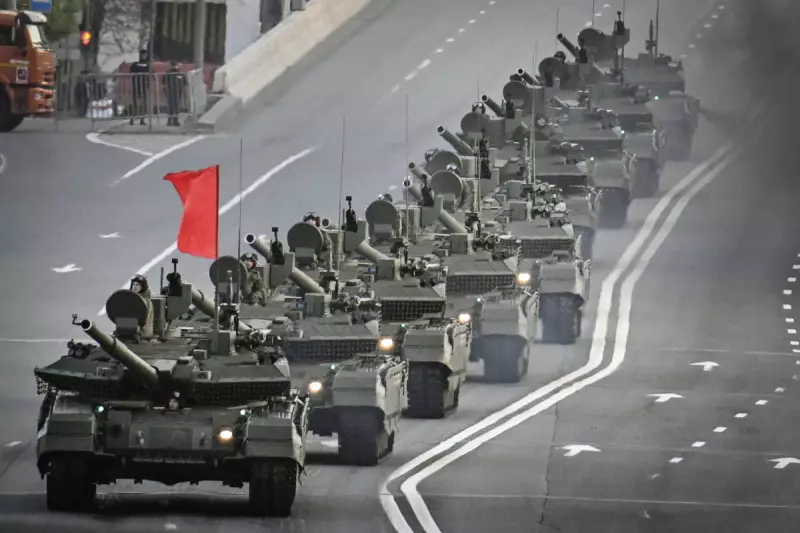
Vladimir Putin's declaration that he is "ready" for war with Europe is a statement that must be taken with deadly seriousness. Amidst the focus on potential US-brokered deals for Ukraine, a third, more dangerous path is emerging: the genuine risk of the war spreading westward into NATO territory.
A Shifting American Stance Weakens European Deterrence
The cornerstone of European security for decades has been the expectation of unwavering American support. That foundation is now cracking. US Treasury Secretary Scott Bessent sent a chilling message to European allies, stating that while Putin makes incursions into NATO borders, the US "is not going to get involved with troops." The American offer, he clarified, is to sell weapons, not to provide direct military backing.
This shift was underscored by Marco Rubio's decision to skip a key NATO summit in Brussels. The collective defence promise of NATO's Article 5 is being fundamentally questioned. If Washington's nuclear deterrent is perceived as solely for its own defence, Russia's vast arsenal becomes a more potent threat against non-nuclear European neighbours.

Vulnerable Frontlines: From the Baltic to the Danube
Russia is already testing boundaries. Its drones and missiles have struck the Romanian side of the Ukrainian border in efforts to disrupt trade along the Danube River. Meanwhile, Ukraine's intelligence agency, the SBU, has conducted sabotage operations against Russian oil tankers far beyond the Black Sea, including in the Baltic.
This creates a direct flashpoint. Retaliation against coastal states like Denmark or Romania, which aid Ukraine, becomes a tangible possibility. Denmark's strategic position, controlling the Baltic Sea's exit, and its new project to manufacture rocket fuel for Ukrainian missiles, make it a potential target. The recent surge in drone sightings across Northern Europe may be more than war psychosis; it could be a Kremlin-led campaign to gauge Western reactions and probe for weaknesses.
Europe's Unpreparedness and the Allure of the Gap
Transatlantic uncertainty exposes deep European vulnerabilities, born from over-reliance on US guarantees. Despite nearly four years of heightened rhetoric since Russia's full-scale invasion in February 2022, many European militaries are weaker. Britain's firepower has shrunk as it donated equipment to Ukraine without replacing it at pace.
While Poland has boosted defence spending, smaller Baltic states like Estonia, Latvia, and Lithuania lack the scale for independent deterrence. Meanwhile, governments in Slovakia and Hungary often portray Kyiv, not the Kremlin, as the core problem. This patchwork of resolve and capability presents dangerous gaps that Moscow might be tempted to exploit, potentially testing NATO's unity with limited aggression.
Putin fundamentally miscalculated his "special military operation" in 2022, expecting a swift, controllable campaign. Wars develop their own brutal momentum. With no peace deal in sight and the US distancing itself from unconditional support, the temptation for Russia to escalate and intimidate its European neighbours is growing. The risk of a wider continental war, once unthinkable, is now a very real and present danger.