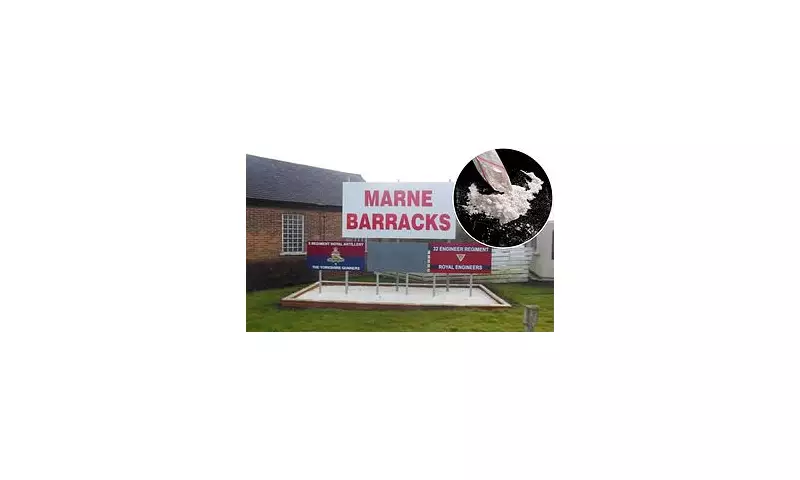
In one of the most significant drug scandals to hit the British Army in recent years, more than 20 soldiers from the same elite regiment have been caught using cocaine. The Daily Mail can reveal that troops from the 32 Engineer Regiment failed a compulsory drug test sanctioned by their commanding officer.
A Culture of Drug Use at the Barracks
The mass failure of the Compulsory Drug Test (CDT) at Marne Barracks, part of Catterick Garrison in North Yorkshire, comes amid alarming reports of drug dealers operating within the barracks itself. The tests were ordered following a raucous 'Boxing Night' celebration before Christmas, where, according to a Royal Engineers source, "a lot of the lads went wild." The source described those involved as "young, stupid and junior," confirming no senior ranks were implicated.
This incident marks a stark challenge to military discipline, with the source adding, "It is so easy to get cocaine at major bases in the UK it is ridiculous." The 32 Engineer Regiment is a crucial unit, providing close engineering support to the 7 Light Mechanised Brigade's combat team and is aligned with the NATO Very High Readiness Joint Task Force—a unit likely to contribute to any future British deployment to Ukraine.

A Shift in Army Policy: Education Over Expulsion?
In a notable reversal from a previously strict zero-tolerance stance, the Army's response to this scandal appears to be evolving. While official policy states that troops caught taking drugs should expect discharge, Commanding Officers now have discretion to retain soldiers under mitigating circumstances such as age, inexperience, or a first offence.
It is understood that while most of the 23 soldiers involved will be discharged, others will be given a second chance, including education on the dangers of substance abuse. This pragmatic approach reflects the Army's struggle to balance discipline with retention, especially given the heightened threat from Russia and a recruitment crisis.
Former senior officer Colonel Hamish de Bretton-Gordon framed the dilemma: "We probably have to look at this through a 2026 lens. More than 20 troops is a disaster and we cannot afford to lose them. Maybe two strikes and you're out is realistic, considering how drug use is embedded in society."
The Broader Context of Army Drug Use
The scandal occurs against a backdrop of fluctuating drug discharge rates within the Armed Forces. Following a lull after Afghanistan, the Army took a harder line, peaking in 2019 with 660 soldiers discharged—equivalent to a full battalion—mostly for cocaine use. Rates fell during Covid lockdowns but have since stabilised at around 500 discharges annually for failed CDTs.
An Army spokesperson reiterated the official line: "Substance abuse is unacceptable in the Army. We robustly enforce a zero-tolerance policy to drug use by all those who serve and provide an education programme to inform all personnel of the dangers and consequences." However, they confirmed an ongoing internal investigation into the 32 Engineer Regiment incident, declining to comment further.
The regiment, formed in 1948 and whose soldiers are historically known as 'Sappers', has a vital skillset including reconnaissance, construction, and launching bridges for crossing obstacles. Their role is now under scrutiny as the Army grapples with a modern societal problem within its historic ranks.