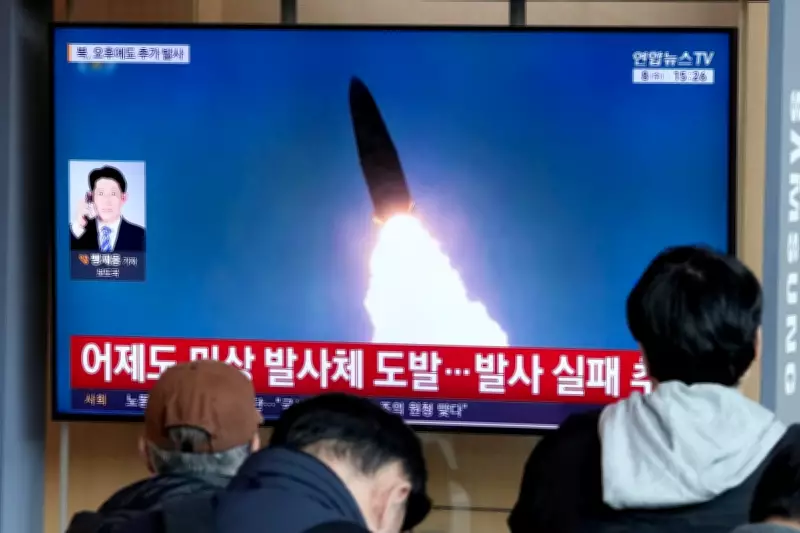
North Korea has announced that its recent series of weapons tests included ballistic missiles equipped with cluster-bomb warheads, as part of a broader effort to enhance its nuclear-capable military forces directed at rival South Korea. The disclosure was made by North Korean state media on Thursday, following a three-day testing spree that commenced earlier in the week.
Details of the Missile Tests
The official Korean Central News Agency (KCNA) reported that the tests, which began on Monday, showcased various new weapons systems. These included demonstrations of anti-aircraft weapons, purported electromagnetic weapons systems, and carbon-fiber bombs. Notably, the tests featured cluster-munition warhead systems mounted on Hwasong-11 ballistic missiles, which are nuclear-capable and designed for low-altitude, maneuverable flight to evade missile defense systems, resembling Russia's Iskander missiles.
According to KCNA, the launches confirmed that these short-range missiles, when armed with such warheads, can devastate targets covering an area of 6.5 to 7 hectares (16 to 17.2 acres) with high-density power. This claim underscores North Korea's ongoing push to expand its military capabilities amid persistent regional tensions.

Regional and International Responses
South Korea's military detected the missile launches, with the Joint Chiefs of Staff reporting that missiles fired on Wednesday traveled distances of 240 to 700 kilometers (150 to 434 miles) before landing in the sea. Additionally, at least one projectile was launched on Tuesday from an area near Pyongyang, the North Korean capital. However, South Korea has not yet commented on the specific military claims made by North Korea regarding the cluster-bomb warheads.
Japan's Defense Ministry stated that none of the weapons fired on Wednesday entered its exclusive economic zone, while the U.S. military assessed that the launches on Tuesday and Wednesday posed no immediate threat to the United States or its allies. Despite this, the tests have highlighted the escalating tensions between North and South Korea, dampening hopes for improved diplomatic relations.
Diplomatic Context and Statements
In a statement issued on Tuesday night, Jang Kum Chol, a first vice minister at North Korea's Foreign Ministry, declared that South Korea would always remain the "most hostile enemy state." He mocked Seoul's liberal government for attempting to revive stalled dialogue, labeling its officials as "world-startling fools." This rhetoric reflects the deepening animosity between the two Koreas.
North Korean leader Kim Jong Un has largely suspended diplomacy with Seoul and Washington since the collapse of nuclear talks with former U.S. President Donald Trump in 2019. Since then, he has accelerated the development of nuclear-capable missiles that threaten U.S. allies in Asia and potentially the U.S. mainland. Kim has also sought to strengthen ties with Russia, China, and other nations in conflict with the United States, aiming to break out of international isolation and bolster his regional influence.
Amid these developments, North Korean state media announced that Chinese Foreign Minister Wang Yi will arrive in the country on Thursday for a two-day visit, signaling ongoing diplomatic engagements between Pyongyang and Beijing. This move is part of North Korea's strategy to forge alliances and counter U.S. pressure in the region.