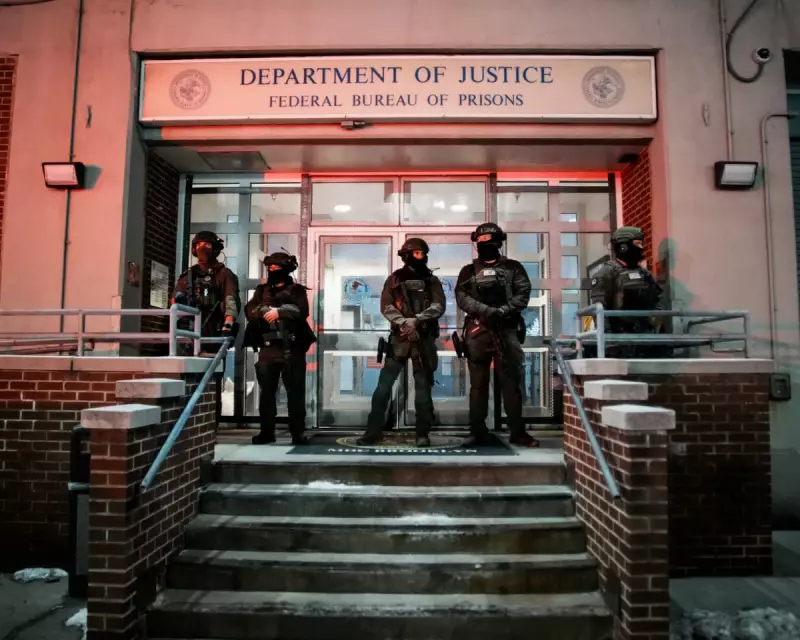
In a dramatic escalation of tensions, the United States has captured Venezuelan President Nicolás Maduro following a military operation, with the leader now reportedly held in a federal detention facility in Brooklyn, New York.
Operation and Capture: The 24-Hour Timeline
The sequence of events unfolded rapidly over Saturday. A plane believed to be carrying Maduro and his wife, Cilia Flores, touched down in New York that evening. Maduro was subsequently taken to the offices of the US Drug Enforcement Administration (DEA) before being transferred to the Metropolitan Detention Center in Brooklyn, according to multiple US media reports.
Visual evidence of the capture emerged via a video posted by the White House's official rapid response social media account. The footage appears to show Maduro, dressed in a black hooded top and hat, handcuffed and escorted by agents down a hallway with a distinctive 'DEA NYD' carpet. In the clip, he is heard saying "Goodnight" and "Happy new year."

Trump's Vision: Running Venezuela and Controlling Oil
Speaking at a press conference on Saturday, President Donald Trump outlined the US's immediate intentions. "We're going to run the country [Venezuela] until such time as we can do a safe, proper and judicious transition," he declared, though he provided no specific timeline or further details.
Trump was unequivocal about US commercial interests, stating that America would be "very strongly involved" in Venezuela's crucial oil industry following the military action. "We have the greatest oil companies in the world... and we're going to be very much involved in it," he said.
In a notable comment, Trump dismissed the potential return of exiled opposition figure María Corina Machado to lead the country, claiming she lacked the necessary support within Venezuela despite being a "very nice woman."
Reactions and the Human Cost
The international response has been one of profound alarm. A spokesperson for UN Secretary-General António Guterres stated he was "deeply alarmed" by the US military action, considering it "a dangerous precedent." The UN Security Council has scheduled an emergency meeting for Monday to address the crisis.
Domestically, Venezuela's supreme court has ordered Vice President Delcy Rodríguez to assume the role of acting president during Maduro's absence.
The human cost of Saturday's attack appears severe. The New York Times, citing a senior anonymous Venezuelan official, reported that at least 40 people, including civilians and soldiers, were killed.
When asked to clarify Trump's statement about "running" Venezuela, US Defense Secretary Pete Hegseth told CBS News it meant that "the drugs stop flowing," that oil taken from US interests would be returned, and that criminals would not be sent to the United States.