
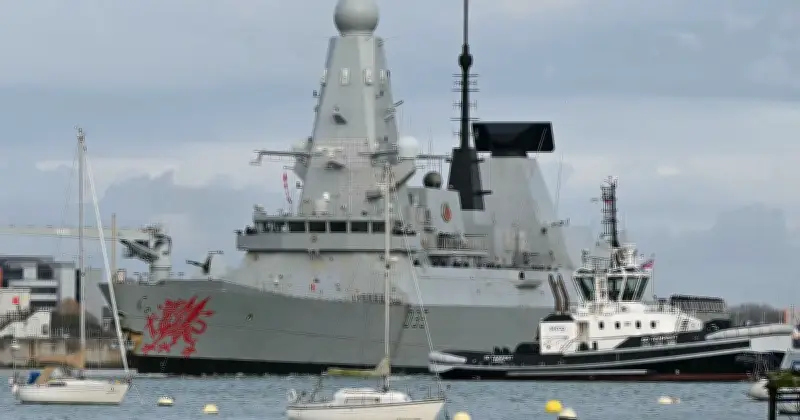
The Government's defence spending plans could spell the end of the Royal Navy as it is known, leaving the UK vulnerable to attack by Russia at a time when NATO warns the threat is at its peak, critics have warned. The Defence Investment Plan (DIP), released a fortnight ago, sets out to scrap the procurement of Type 83 Destroyers to replace ageing destroyers, instead procuring at least six so-called “common combat vessels” (CCVs) that will serve as command hubs for uncrewed systems.
Transition to Uncrewed Systems Leaves Critical Gap
Mike Martin MP, a member of both the Defence Select Committee and the Joint Committee on National Security Strategy, warned that the transition from warships to autonomous vessels leaves the UK vulnerable. According to Martin, who served in Afghanistan, the time period between warships going out of service and uncrewed systems coming into service could leave the UK unable to counter Russian activity in the high north.
Martin told the Sunday Express: “According to the Defence Investment Plan, the UK will be left with just three frigates in 2030. That is the time when NATO says we are going to be under the peak Russian threat. Ultimately, that will mean we will only ever be able to have one at sea as a maximum. On top of that, you then have destroyers that will be phased out in 2035.”
German Army chief Lieutenant General Christian Freuding warned last month that all 32 NATO members agree that Vladimir Putin could have the capability to launch a large-scale assault on allied territory before the end of the decade.
Shift to Hybrid Navy
The plans come as First Sea Admiral General Sir Gwyn Jenkins leads efforts to shift towards a new “hybrid Navy” made up of both traditional crewed ships and submarines and autonomous vehicles and AI. In a significant change, the Royal Navy will move away from reliance on a small number of large and expensive platforms.
Defence Secretary Dan Jarvis said: “These Common Combat Vessels will provide our dedicated sailors with hybrid ships that are designed and built for the increasing threats we face. Developed with exceptional British innovators, the new ships will be British-built, supporting jobs across the nation and giving the Royal Navy a capability built for modern warfare.”
Russian Probing of NATO Defences
It comes as Russia continues to probe NATO’s defences on land, air and sea. Earlier this year, then Defence Secretary John Healey confirmed that the UK and allies tracked a Russian attack submarine and two spy submarines loitering over critical undersea cables in the North Atlantic for a month. The UK deployed a warship and aircraft to deter “malign” activity by Moscow in waters off the UK’s northern coast.
500 British personnel were involved in the month-long operation, with RAF crews flying more than 50 sorties using P-8 Poseidon submarine-hunting aircraft, supported by allied countries including Norway. The submarines were within the UK’s exclusive economic zone, extending up to 200 nautical miles offshore, but not within Britain’s territorial waters.
Concerns Over Ballistic Missile Defence
Martin believes the decision to phase out destroyers will reduce the service’s ability to track, monitor and deter future Russian incursions. He added: “It means there is no defence and ability to protect our undersea cables. We have a reduced ability to defend against ballistic missiles. Ultimately, we are unable to counter Russian activity. A third of the Royal Navy’s time is currently spent doing just that. That is increasing. Under these plans, we will be unable to do that effectively until these new autonomous systems, which are currently nothing more than a powerpoint, are brought into service. It is effectively the end of the Royal Navy as we know it.”
Former Royal Navy commander and Defence Attaché to Moscow and Kyiv, John Foreman, told the Sunday Express that the service is in danger of losing its ballistic missile defence capability, labelling it “irresponsible”. He said: “I’m deeply concerned about the unproven path the Navy has embarked on which is driven by concerns about affordability not capability. The Royal Navy in its revolutionary zeal risks forgetting its own lessons from the past about evolution, trials, independent analysis. By slagging off ‘exquisite and expensive’ crewed platforms the Navy has opened the door as I predicted for MoD bean counters to call their bluff and force it down the uncrewed route. None of these systems are anywhere near ready for operational deployment, and there are some mighty issues of engineering, support and physics to overcome. Setting a target of 2035 to start removing type 45 from service is irresponsible. Drones don’t work against Mach 10 ballistic missiles. No other Navy is going down this path. I suspect there will be a course correction in due course when reality bites. Destroyers exist for a reason. To cancel Type 83 without a proven path to replace the capability risks the deaths of our sailors.”
MOD Response
A Ministry of Defence spokesperson said: “We are transforming the Navy with new crewed surface ships, powerful aircraft carriers, and state-of-the-art crewed, uncrewed and autonomous systems. This includes building eight of the world’s most advanced anti-submarine warfare ships, the Type 26 Frigates, and five general purpose Type 31 Frigates. In the future, the Navy’s Common Combat Vessel will deliver the UK’s most advanced maritime air defence capability and keep British shipyards working for years to come.”




