

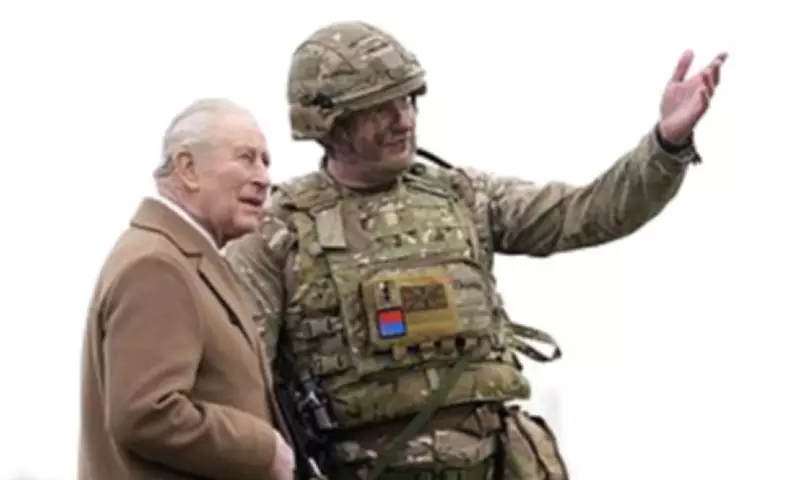
King Charles Practices Drone Defence During Army Base Inspection
King Charles received a hands-on lesson in modern warfare technology during a visit to Bakers Barracks on Thorney Island this Thursday. The monarch, who arrived by helicopter wearing a suit and regimental tie, was greeted with a 21-gun salute and hundreds of military personnel alongside their families.
Immersive Air Defence Demonstration
The King witnessed an eight-minute immersive air defence demonstration showcasing the unit's short-range and medium-range capabilities. The exercise featured three separate waves of drones and two armoured vehicles, highlighting contemporary battlefield scenarios.
During the demonstration, Charles looked through the sight unit of an air defence missile launcher, simulating target acquisition of an enemy drone approximately 30 feet above. Although he did not fire the equipment, he actively participated by turning the sight left and right while asking detailed questions about its operation.

Hands-On Equipment Experience
The King entered a camouflage net where soldiers demonstrated a lightweight multiple launcher (LML), a system capable of eliminating targets within approximately four seconds if fired. Lieutenant Colonel Maarten Magee, who guided the monarch through the demonstration, later commented on Charles' engagement.
'What an absolute privilege to have him speak to our soldiers, see our equipment, and get hands on the kit that we use every day,' Magee stated. 'As an aviator himself, air defence has always been something he's been interested in, but he was more interested in how we're dealing with modern threats, particularly drone technology.'
Magee added that the King appeared surprised by the operational difficulty, noting 'the lesson he probably took from that was how hard it is to acquire a target.' Another soldier remarked that Charles would have passed if the activity had been formal training.
Connecting with Deployed Personnel
Following the demonstration, King Charles officially opened the new Junior Ranks' Restaurant, unveiling a plaque draped with a Union flag to cheers from school children and local residents. Inside the facility, he spoke via live link with deployed personnel stationed in the Falklands, Saudi Arabia, Estonia, and Cyprus.
'Thank you all very much for all your efforts, they're much appreciated they really are,' the King told the remote personnel, adding humorously, 'Is it the middle of your lunch?' to laughter from those present.
Personal Interactions with Military Families
The visit included meaningful interactions with military families. Charles spoke with Sergeant Jack Harding's family, whose five-year-old daughter Poppy handed the King a letter she had written with her mother. The monarch told Harding, who has been deployed in the Falklands since October, 'It won't be long hopefully until you're back, only another month or two. Well done.'
He also met Jade McGowan, mother of seven-month-old twins, acknowledging the challenges faced by military spouses with the words, 'Poor old long suffering other halves. I don't know how you do it, you're amazing.'
Additional Engagements and Historical Context
During his visit, King Charles met members of the Force Atlantic rowing team, who completed a 45-day Atlantic crossing in January, inquiring about their physical condition with 'Not too many blisters, I hope.' He also engaged with serving Commonwealth personnel and local faith leaders.
A ceremonial moment occurred when Charles cut a cake featuring the blue and yellow centaur insignia of the 7th Air Defence Group. Upon seeing the cake's size, he remarked, 'I'll need an enormous sword,' before examining a piece and commenting on the Victoria sponge.
Thorney Island, located on the peninsula in Chichester Harbour bordering Hampshire and West Sussex, serves as headquarters for the 7th Air Defence Group, which provides all of the UK's ground-based air defence assets. The island was first used as a Royal Air Force base during the Second World War, with Baker Barracks constructed in the 1980s.

King Charles holds the historic title of Captain General of the Royal Artillery, a position first assumed by King George VI in 1947 and subsequently held by Queen Elizabeth II from 1952. The Royal Artillery, founded in 1716 and comprising 14 regular and seven reserve regiments, describes itself as the British Army's 'eyes, ears and firepower.' Three of its regiments form the units of the 7th Air Defence Group that were the focus of the royal visit.





