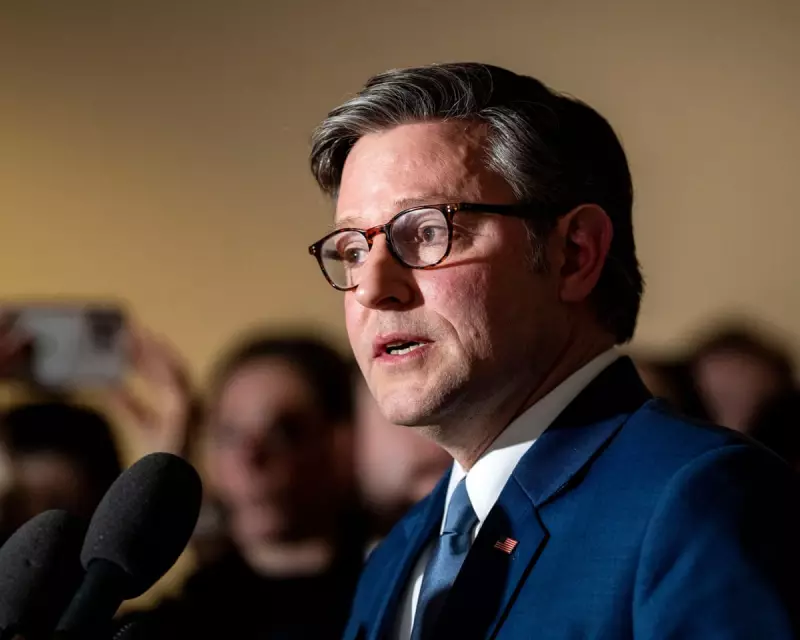
House Speaker Mike Johnson has declared the United States is "not at war" with Venezuela, following a controversial military operation ordered by President Donald Trump to capture the country's leader, Nicolás Maduro.
Briefing Leaves Democrats with More Questions
The Republican leader made the statement to reporters on Monday after a closed-door briefing with top administration officials, including Secretary of State Marco Rubio and Defence Secretary Pete Hegseth. The briefing was called in the wake of a surprise weekend incursion which saw Maduro arrested and the US announce it would now "run" the South American nation.
Johnson sought to downplay the scale of US involvement, stating, "We are not at war. We do not have US armed forces in Venezuela, and we are not occupying that country." He rejected Democratic claims that Trump broke the law by not seeking authorisation from Congress ahead of the attack, framing it as a demand for behavioural change rather than regime change.

Administration's Justification and Democratic Alarm
The Trump administration has justified its actions by alleging Maduro ran a "narco-terrorist" government, facilitating drug trafficking into the US and providing a foothold for rivals like China and Russia. Maduro, arrested with his wife, has pleaded not guilty to federal charges in New York.
However, Democratic Senate Minority Leader Chuck Schumer said the briefing "posed far more questions than it ever answered." He warned the US was on the precipice of being drawn into a new, protracted conflict, criticising the plan for running Venezuela as "vague" and "based on wishful thinking."
Schumer expressed deep concern, stating, "I did not receive any assurances that we would not try to do the same thing in other countries… When the United States engages in this kind of regime change and so-called nation building, it always ends up hurting the United States."
Congressional Pushback and Future Strategy
The raid has sparked significant controversy on Capitol Hill. Democratic senators plan to force a vote on a war powers resolution this week to require congressional approval for any further military action in Venezuela. Meanwhile, the administration's decision to exclude judiciary committees from the briefing prompted a rare bipartisan rebuke from Senators Chuck Grassley and Dick Durbin.
Republican Congressman Brian Mast, chairman of the House Foreign Affairs Committee, defended the operation, comparing it to the killing of Iranian General Qassem Suleimani. He argued it was a swift action that did not require prior congressional authorisation and would not lead to a long-term troop commitment.
Johnson predicted that existing US sanctions, which have seized Venezuelan oil exports, would force political change and lead to new elections. He confirmed that administration officials will return to brief all lawmakers on the Venezuela strategy on Wednesday, as international condemnation grows, with dozens of countries at the UN Security Council denouncing the incursion as a "crime of aggression."