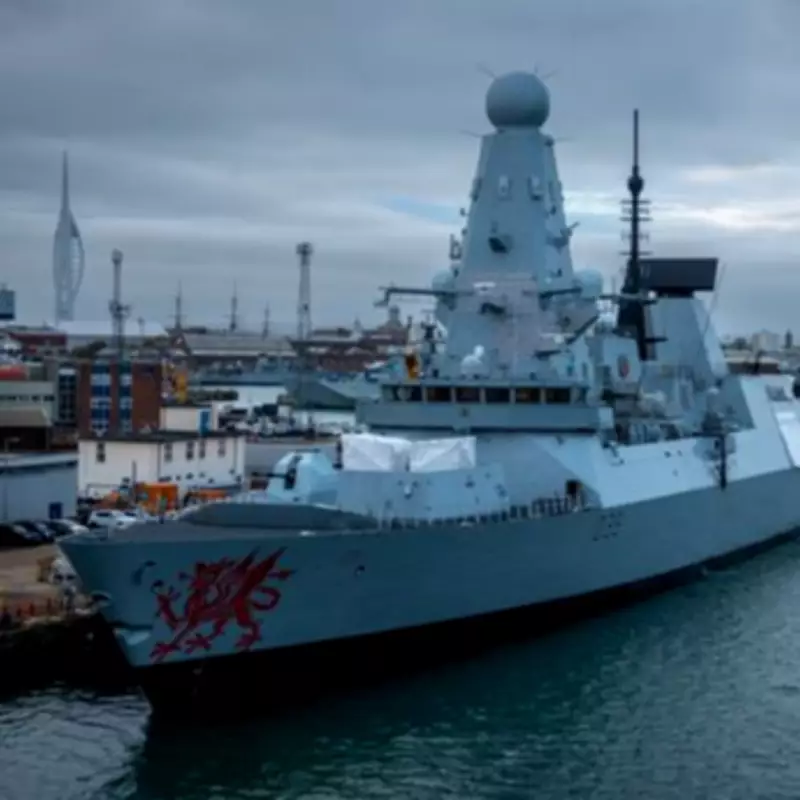
Prime Minister Keir Starmer has made a decisive move in response to escalating tensions in the Middle East, selecting the formidable HMS Dragon for deployment to the Mediterranean region. This critical decision follows an incident at RAF Akrotiri in Cyprus, where damage was inflicted on the base's landing strip, with initial assessments pointing to an Iranian Shahed drone as the likely culprit.
Strategic Deployment Amid Regional Unrest
The HMS Dragon, a £1 billion Type-45 Daring class destroyer, represents one of the Royal Navy's most sophisticated assets. While Cypriot officials have characterized the damage to RAF Akrotiri as "limited," the British government has opted for a precautionary stance, dispatching the warship to bolster regional security. This deployment occurs against the backdrop of complex geopolitical dynamics involving Israel, Iran, and broader international concerns.
Formidable Naval Capabilities
The HMS Dragon is an imposing vessel, measuring 152.4 meters in length and 21.2 meters in width, with a displacement ranging between 8,000 and 8,500 tonnes. Its primary mission is to provide comprehensive protection to allied ships by detecting, interrogating, and neutralizing potential threats. This capability is largely enabled by the advanced Sea Viper anti-air missile system, which the Royal Navy asserts can effectively counter even supersonic targets.

The destroyer's arsenal is both extensive and formidable, featuring:
- 72 Sea Viper missiles
- CAMM launcher cells
- A 4.5-inch (114 mm) Mark 8 naval gun
- Phalanx Close-In Weapon System (CIWS)
- 30mm guns
This sophisticated weaponry is managed and operated by a dedicated crew of 200 personnel, who are responsible for long-range target acquisition, helicopter maintenance, and the upkeep of all onboard weapons systems.
The Alternative Considered: HMS Duncan
Prior to finalizing the deployment decision, Prime Minister Starmer reportedly evaluated two advanced destroyers. The HMS Duncan, the sixth Type-45 destroyer in the Royal Navy's fleet, was the other vessel under consideration. While the Duncan shares many characteristics with the Dragon—including similar dimensions, weight, and the Sea Viper system—it is generally regarded as slightly less advanced than its counterpart now en route to the Mediterranean.
The HMS Duncan, constructed at a cost of approximately £400 million, remains anchored at Portsmouth Naval Base. It possesses comparable capabilities, including the Sampson radar system and the ability to launch up to eight missiles within a ten-second window, guiding them across distances of up to 70 miles. Like all Type-45 destroyers, the Duncan is versatile, participating in missions ranging from air defense operations to humanitarian assistance.
Cultural Significance and Recognition
Beyond its military prowess, the HMS Dragon holds a unique place in popular culture. The vessel is instantly recognizable by the Welsh Dragon emblem proudly displayed on its bow. It achieved cinematic fame with a notable appearance in the 2021 James Bond film No Time To Die. In the movie, the fictional MI6 chief M orders a missile strike from the Dragon on a Japanese island used by the villain Safin to develop a dangerous bioweapon, a dramatic sequence that culminates in the demise of Daniel Craig's incarnation of James Bond.
This deployment underscores the UK's commitment to maintaining stability and security in a volatile region, utilizing one of its most capable naval assets. The HMS Dragon's journey to the Mediterranean marks a significant moment in contemporary defense strategy, blending cutting-edge military technology with strategic geopolitical positioning.