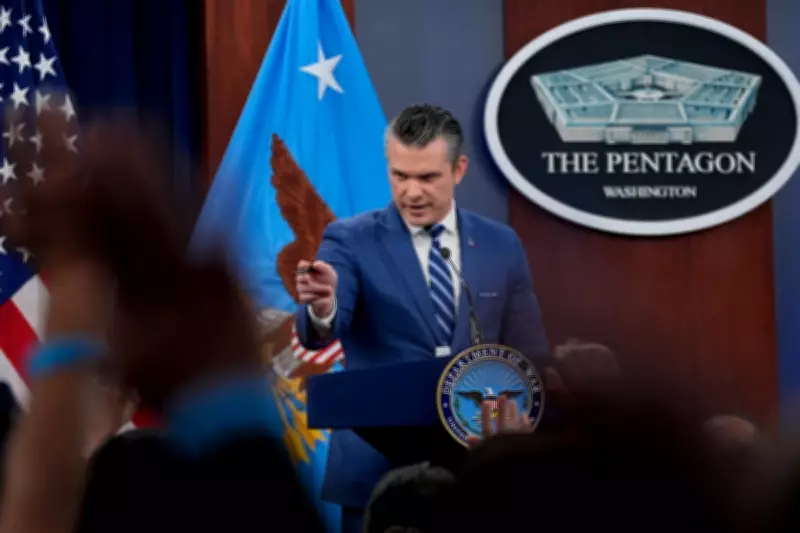
In a dramatic press conference at the Pentagon, US Defence Secretary Pete Hegseth declared that Iran had "begged" for a temporary ceasefire after American military strikes decimated the nation's defence infrastructure. The briefing, held on Wednesday, marked the first public comments from the defence secretary since former President Donald Trump announced a two-week pause in hostilities the previous night.
Operation Epic Fury's Devastating Impact
Standing alongside Joint Chiefs Chair Dan Caine, Hegseth detailed the extensive damage inflicted during what he termed "Operation Epic Fury." He asserted that the final wave of strikes before Trump's self-imposed deadline had "completely destroyed Iran's defence industrial base," reducing weapons factories to rubble and rendering the military "combat ineffective for years to come."
"Iran begged for this ceasefire, and we all know it," Hegseth told assembled reporters, suggesting divine providence had played a role after forty days of conflict. While acknowledging Iran could still fire stockpiled weapons, he emphasised they could no longer manufacture replacements, creating what he described as a strategic advantage for the United States.

Ceasefire Negotiations and Conflicting Claims
The ceasefire agreement emerged following last-minute intervention by Pakistan's Prime Minister Shehbaz Sharif and Army Chief General Asim Munir, with Trump announcing the suspension on Truth Social less than two hours before his deadline to "decimate the entirety of Iranian civilization." Iran's Foreign Minister Abbas Araghchi confirmed acceptance shortly thereafter, with Tehran's supreme national security council announcing a delegation would travel to Islamabad for formal talks beginning Friday.
Despite Hegseth's characterisation of Iranian desperation, Tehran declared its own victory, with its security council stating "nearly all the objectives of the war have been achieved." The conflict began on 28 February when the US and Israel launched nearly 900 strikes against Iranian military infrastructure, missile facilities, and leadership targets, resulting in the death of Supreme Leader Ali Khamenei on the first day.
Human and Financial Costs Mount
General Caine confirmed thirteen US service members were killed during the five-week war, with regional death tolls exceeding 5,000 individuals. This includes over 1,600 Iranian civilians and at least 1,497 people in Lebanon. Financially, the US military had expended approximately $12.7 billion by the sixth day of conflict, with a $200 billion supplemental funding request currently pending before Congress.
Contradictory Terms and Regional Uncertainties
The terms of any potential lasting agreement remain openly contradictory. Trump posted on Wednesday morning that Iran would surrender its enriched uranium with "no enrichment" moving forward, while Iran's ten-point counter-proposal explicitly demands the right to continue enrichment activities.
The ceasefire itself faces regional disputes, with Israel asserting it does not cover Lebanon, where ground and air campaigns have escalated to their largest scale since Israel's northern invasion. Both Pakistan and Iran have stated the ceasefire includes Lebanon, creating significant ambiguity. Post-ceasefire incidents include Israel seizing an Iranian missile file and Kuwait along with the United Arab Emirates reporting Iranian missile and drone attacks.
Ongoing Threats and Military Posture
Iran's supreme national security council warned that "our hands are on the trigger, and the moment the enemy makes the slightest mistake, it will be met with full force." Hegseth mirrored this defiant tone when questioned about US forces' regional presence, stating bluntly: "We're not going anywhere."
The defence secretary emphasised that what ultimately compelled Iran to negotiate was the threat of subsequent strikes targeting power plants, bridges, and energy infrastructure—targets he described as indefensible and requiring decades to rebuild. This looming threat, combined with the extensive damage already inflicted, formed the backdrop to what Hegseth characterised as a ceasefire born from Iranian desperation rather than mutual concession.