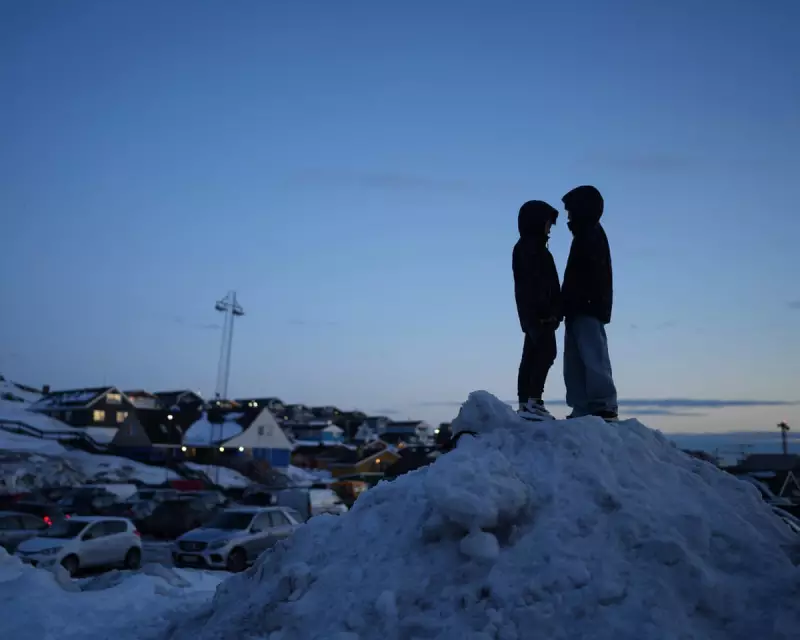
The government of Greenland has issued a forceful rejection of former US President Donald Trump's stated desire to acquire the vast Arctic territory, declaring it "cannot under any circumstances accept" such a prospect. The self-governing island, which is part of the Kingdom of Denmark, has simultaneously moved to reinforce its defence commitments within the NATO alliance.
Diplomatic Standoff Over Strategic Arctic Territory
At the start of a critical diplomatic week, Trump reiterated his interest in the mineral-rich and strategically located island, stating the United States would take control "one way or the other." This provocative stance has sent shockwaves through NATO and the European Union, particularly as Trump has refused to rule out the use of military force. Denmark, which handles Greenland's foreign and defence policy, has repeatedly stated the island is not for sale and hopes for a diplomatic resolution.
In a clear statement of its constitutional position, Greenland's government, based in the capital Nuuk, emphasised that the island is "part of the kingdom of Denmark" and, "as part of the Danish commonwealth, a member of NATO." It announced plans to increase efforts to ensure its defence is managed "in the NATO framework." The ruling coalition asserted its belief that Greenland will forever remain part of the Western defence alliance and that all NATO members share a common interest in its security.

NATO's Arctic Focus and International Reactions
The controversy unfolds as NATO itself is examining ways to bolster security in the increasingly important Arctic region. NATO Secretary General Mark Rutte confirmed the alliance is "working on the next steps" to collectively protect shared interests, citing concerns about heightened Russian and Chinese activity as sea lanes open. Rutte welcomed discussions among allies on Arctic security but did not directly address Trump's comments on Greenland.
The EU's defence commissioner, Andrius Kubilius, delivered a stark warning, suggesting that any US military action against Greenland would mean "the end of NATO." He pointed to the EU's mutual assistance clause, Article 42.7, which could oblige member states to aid Denmark if it faced aggression, though legal experts note complexities as Greenland is outside the EU.
International reactions have been swift. China criticised the US interest, with foreign ministry spokesperson Mao Ning stating the Arctic concerns the overall interests of the international community and calling for all nations' rights to conduct lawful activities there to be respected. Meanwhile, a delegation of US senators, including Alaska's Lisa Murkowski—who previously said acquiring Greenland "should not be on [the US's] list"—is scheduled to visit Copenhagen for talks.
Historical Context and Future Pathways
Denmark has highlighted that a 1951 treaty already grants the US significant scope to expand its military presence in Greenland, home to the Thule Air Base. This historical context underscores the existing deep defence ties between Copenhagen and Washington.
Amid the crisis, some European figures have proposed novel solutions. Germany's former vice-chancellor, Robert Habeck, suggested in the Guardian that the EU should explicitly offer membership to Greenland, as well as to Iceland, Norway, and the Faroe Islands, as a "pragmatic and phased" proposal to fend off external interest. Greenland left the European Community in 1985 after gaining home rule, but Habeck argues the geopolitical landscape has "entirely altered" since.
As Greenlandic foreign minister Vivian Motzfeldt and Danish counterpart Lars Løkke Rasmussen prepare to meet US Secretary of State Marco Rubio in Washington, the island's representatives stress the need for clear dialogue. Aaja Chemnitz, chair of the Danish parliament's Greenland committee, noted that "lots" of incorrect claims are circulating and it is "absolutely crucial we get some truths on the table."