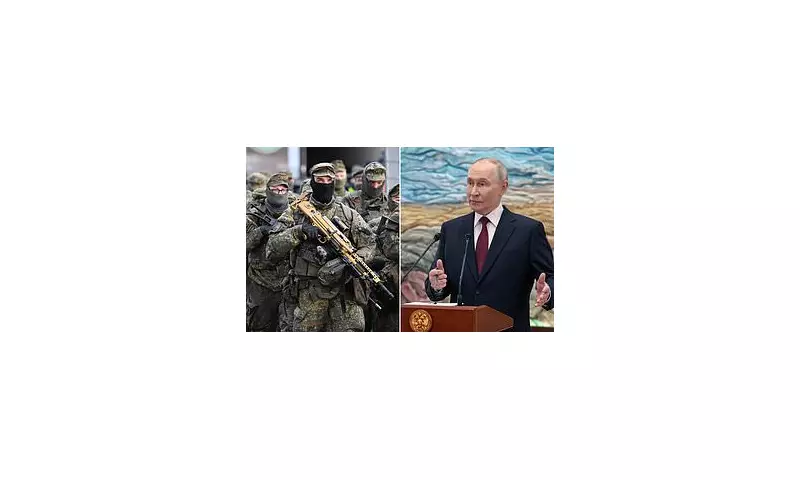
Germany has secretly developed an extensive 1,200-page military blueprint outlining how up to 800,000 NATO troops would be rapidly deployed to Europe's eastern frontlines in response to a potential Russian attack on the alliance.
The Classified Operation: OPLAN DEU
The covert operation, known as OPLAN DEU, was compiled in secrecy by a select group of senior officers working from the Julius Leber Barracks in Berlin. This comprehensive plan comes amid growing concerns from intelligence agencies that Moscow's recent sabotage attempts, drone incursions and espionage activities across Europe could signal preparations for an imminent confrontation.
According to reports from the Wall Street Journal, the document meticulously details how German, American and allied forces would be transported from western ports and airfields to the eastern front. The strategy relies on a network of roads, railway links and rivers that planners acknowledge have been significantly weakened by decades of underinvestment.

The blueprint also addresses critical security measures, outlining how military convoys would be protected from sabotage attempts, misinformation campaigns and drone attacks during their movement eastward.
Urgent Timelines and Infrastructure Challenges
German officials have consistently warned that Russia could rebuild sufficient military capacity to threaten a NATO member state by 2029. However, senior figures now believe Moscow might act sooner, particularly if a temporary ceasefire in Ukraine frees up additional troops and equipment for other operations.
Analysts emphasise that Europe's geographical reality positions Germany as the crucial transit route for any major reinforcement effort. "With the Alps forming a natural barrier, NATO troops would have to cross Germany," explained Tim Stuchtey of the Brandenburg Institute for Society and Security.
The plan represents a significant strategic shift for Germany, which systematically dismantled much of its Cold War-era military infrastructure. Current assessments reveal that large portions of the road and rail network cannot support heavy military vehicles, while many bridges lack the strength to bear armoured convoys.
Government estimates indicate that 20% of highways and more than a quarter of highway bridges require urgent repairs. Meanwhile, ports in the North Sea and Baltic Sea need approximately €15 billion in upgrades to meet military requirements.
Testing and Implementation Challenges
Elements of this new defence strategy underwent testing during large-scale exercises this autumn. In one notable drill, defence contractor Rheinmetall successfully constructed a camp for 500 soldiers, complete with showers, fuel stations and drone surveillance, within just 14 days.
However, the exercises also exposed significant problems. Some sites proved too small for the intended number of military vehicles, while others were inconveniently spread across separate land plots. In a previous test, a military convoy experienced substantial delays due to traffic congestion, requiring the installation of an entirely new traffic light system to resolve the issue.
Deputy Defence Minister Nils Schmid acknowledged the challenges, stating, "We must relearn what we unlearnt. We have to drag people back from retirement to tell us how we did it back then."
The current version of OPLAN DEU is stored on an isolated internal system known as the 'red network' and is expected to undergo repeated revisions as Germany prepares for potential conflict scenarios.
Growing Threats and European Response
The security environment across Europe has deteriorated rapidly in recent months. Vladimir Putin has been accused of multiple provocations, including violations of NATO members' airspace using drones and fighter jets.
In September, several Russian drones targeting Ukraine crossed into Polish territory, striking an elderly couple's home and destroying its roof. Analysts noted that the incident could have triggered a major international crisis if the occupants had been killed.

That same month, NATO fighter jets were scrambled when three Russian MIG-31 aircraft entered Estonian airspace, remaining there for twelve minutes. Similarly, Copenhagen Airport, Denmark's busiest aviation hub, was forced to close for several hours after suspected Russian drones were observed flying over its runway, disrupting travel for over 20,000 passengers.
European Union officials have repeatedly warned that Russia is engaged in a proxy war with Europe, though the Kremlin consistently denies these allegations.
The development of OPLAN DEU commenced shortly after Russia launched its full-scale invasion of Ukraine in 2022. Former Chancellor Olaf Scholz announced a €100 billion rearmament package, while the military established a new Territorial Command specifically tasked with creating the comprehensive defence plan.
Other European nations are also enhancing their preparedness. France recently revealed plans to reintroduce military national service for both men and women aged 18, while Poland announced it would begin military training for all adult males. Several countries bordering Russia, including Poland, Lithuania, Latvia and Estonia, have withdrawn from the Ottawa Convention banning anti-personnel landmines.
As Chancellor Friedrich Merz starkly declared in September, "The threats are real. We're not at war, but we no longer live in peacetime." The race to bolster European defences continues as security analysts warn that the window for preparation may be closing faster than anticipated.