
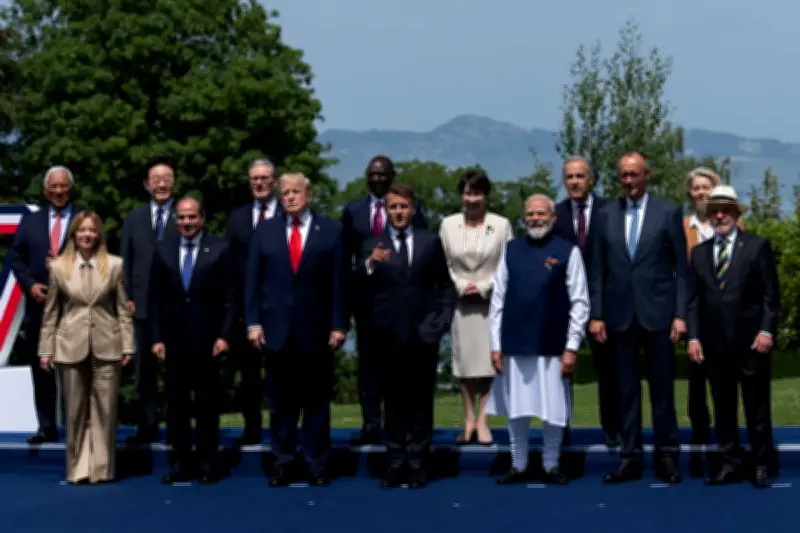
World leaders, alongside the European Council president and the European Commission president, gathered for a group photo at the G7 summit in Evian-les-Bains, France, on Tuesday. The summit underscores the urgent need for Europe to fast-track its strategic independence in a volatile world.
The Challenge of Strategic Autonomy
A recent paper from the European Council on Foreign Relations describes Europe's leaders as grappling with a 'Schrödinger's NATO' moment, where the US remains formally in the alliance while behaving as though it were not, as the Russian threat looms larger. Donald Trump's United States has become an unreliable ally, exposing the need to strengthen Europe's defences.
Failed Franco-German Fighter Jet Project
If greater autonomy is to be achieved, far better coordination of resources and cooperation between national defence industries is required. However, this month France and Germany abandoned a joint £100bn project to build a new fighter jet as part of the Future Combat Air System. Originally launched by Emmanuel Macron and Angela Merkel in 2017, the project collapsed due to irresolvable disagreements between Dassault and Airbus over technology transfer and Dassault's desire to lead.
The collaboration, one of the biggest in EU history, foundered due to industry interests prevailing over security. Spanish defence minister Margarita Robles expressed deep concern, stating that industry interests were placed over Europe's security.
France's Defence Status and Resource Limitations
France's heavyweight defence status has been a source of national pride, but it lacks resources to modernise alone in an era of great power rivalry. New technologies are transforming warfare and deterrence. Other EU countries, including Germany and the UK, also lack sufficient resources. The risk is continued reliance on US technology, such as the F35 fighters, whose use depends on Washington's goodwill. Reported US pressure on Italy over the 'Michelangelo Dome' AI air defence system indicates Washington will not give up its influence easily.
EU Defence Coordination Efforts
An embryonic structure of coordination has emerged in Brussels. In 2024, the EU published the first European Defence Industrial Strategy, and the Security Action for Europe mechanism provides 150bn euros in low-interest loans for defence investment. More needs to be done to build on that platform.
Greater access to pan-European funding models can alleviate pressure on national budgets. Future subsidies and grants could be tied to projects prioritising joint development and industrial collaboration. Not everything needs to go through Brussels; the multilateral defence mechanism launched by Britain with Finland and the Netherlands is an example of a complementary financing track.
G7 Summit and Ukraine
As G7 leaders meet in Evian, another European charm offensive is being mounted to convince Trump to exert more pressure on Putin over Ukraine. This work is necessary, but so is the strategic transformation that would leave the EU less reliant on diplomatic flattery and persuasion.




