
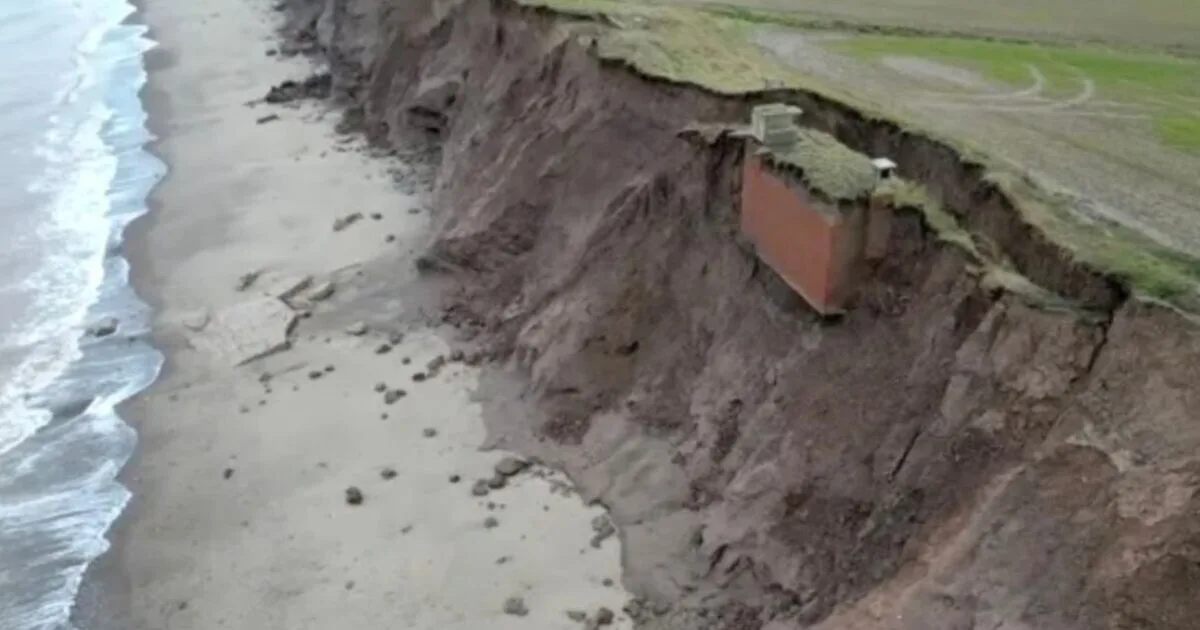
A Cold War nuclear bunker perched on a cliff in East Yorkshire is expected to fall into the sea within days due to coastal erosion. The brick structure, known as the Tunstall ROC (Royal Observer Corps) Post, was built in the 1950s as a lookout post in the event of a nuclear war.
Amateur historian Davey Robinson, who has been monitoring the site daily with his partner Tracy Charlton, said the bunker has 'perhaps a few days' left. He told the BBC the bunker was designed for people to live inside, register nuclear explosions, and relay information to other bunkers across Britain.
The bunker is believed to have been constructed in 1959 and decommissioned in the early 1990s after the Cold War ended. It is one of many such posts across the UK, according to Subterranea Britannica, a society focused on underground structures.
Mr Robinson said the bunker symbolises the rapid coastal erosion in the area. The Climate Change Committee warns that erosion will accelerate due to global warming, endangering properties, infrastructure, and ecosystems. Analysis by the charity One Home lists 21 coastal communities at risk, including villages in East Yorkshire, Norfolk, and Cornwall, with up to 2,218 properties potentially lost by 2100 at a cost of £584 million.
Recent cliff collapses in Newhaven and West Bay highlight the growing threat of erosion along Britain's coasts.




