
On Wednesday, July 3, 1940, Winston Churchill, serving as Prime Minister for just 55 days, faced one of his most controversial wartime decisions. The destruction of the French fleet, ordered by Churchill, remains a deeply debated act. However, many historians argue that no action was more necessary for Britain's survival.
The Context of the Decision
By mid-1940, Britain stood alone against Nazi Germany. Italy had joined forces with Hitler, the evacuation of 330,000 British troops from Dunkirk had been completed, and much of Western Europe had fallen. Churchill, who had been woken at dawn with his breakfast and dispatch box, spent the morning in bed reviewing papers. Among the pressing issues, the fate of the French fleet caused him the greatest concern.
As Britain's closest ally crumbled under German assault, there was a real risk that the French Navy, the fourth-largest in the world, could fall into Hitler's hands. This would have threatened Britain's ability to control vital shipping lanes. The Royal Navy was Churchill's primary military advantage, and the loss of even a fraction of the French fleet was intolerable.
Operation Catapult
Churchill ordered Operation Catapult, a complex plan with a brutal objective: the French must ensure their fleet could not fall to Germany, or the British would destroy it by force. The French admirals had dispersed most of their 800,000 tons of warships to bases worldwide, but they remained vulnerable. The centerpiece of the French fleet was the battleships Dunkerque and Strasbourg, along with nine other ships at Mers-el-Kébir in Algeria, forming France's Force de Raid.
Vice Admiral Gensoul, commanding from Dunkerque, was a proud patriot with deep suspicions of the British. Unbeknownst to him, British Force H, led by Vice Admiral Somerville aboard HMS Hood, was approaching. Somerville sent Captain Holland, a skilled French speaker, ahead to negotiate with Gensoul.
The Ultimatum
Holland presented four options: sail to Britain and continue fighting, sail to the West Indies or America for disarmament, scuttle the fleet, or hand it over to the British. If none were accepted, the British would destroy the fleet. The code word for attack was ANVIL.
Gensoul was insulted by Holland's junior rank and refused to meet him for nearly twelve hours. He stalled to rearm his fleet and prepare for escape or battle. Churchill waited anxiously at 10 Downing Street, receiving updates from Somerville, who had orders to resolve the matter by nightfall.
The Attack
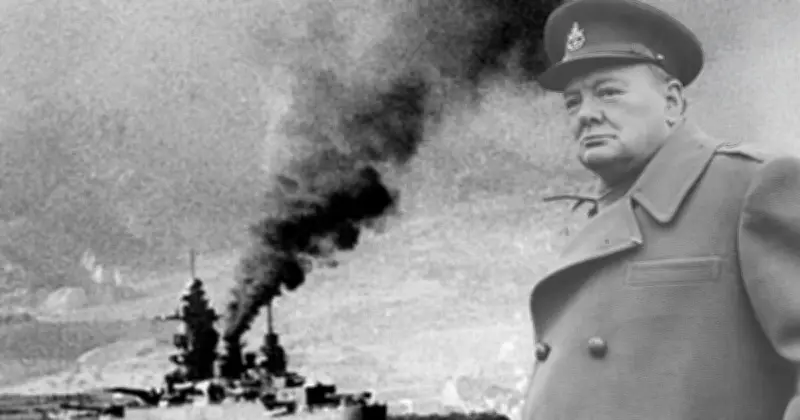
At 17:54 hours, with negotiations stalled, Somerville ordered ANVIL. The French fleet, trapped in the harbor, faced ferocious shelling from British ships screened behind a peninsula. After ten minutes, a ceasefire was called. The devastation was immense: Dunkerque was grounded, Provence ablaze, and Bretagne had capsized, killing most of its 1,193 crew. Bodies floated in oil-black water, and rescue boats picked through debris. The fleet's chaplain, Father de Gueuser, rowed through the wreckage, blessing everything he encountered.
Somerville was despondent, writing to his wife, "That filthy job is over at last. What other butcher's work awaits me?" News soon arrived that Strasbourg had escaped under cover of the bombardment, escorted by four destroyers. Despite a torpedo attack from HMS Ark Royal, Strasbourg reached Toulon to cheering crowds.
Aftermath and Significance
In total, four ships were put out of action, 1,299 men killed (1,297 French), and 351 wounded. Two British airmen died in a dogfight. Despite some vessels escaping, the operation was deemed a success. Churchill called it "a hateful decision, the most unnatural and painful... a Greek tragedy. But no act was ever more necessary for the life of Britain."
The attack proved crucial for American support. President Franklin D. Roosevelt, previously unconvinced of Britain's resolve, was swayed by Mers-el-Kébir. Harry Hopkins, Roosevelt's advisor, told Churchill's private secretary John Colville: "It was Mers-el-Kébir which convinced President Roosevelt... that the British really would go on fighting." Soon after, Roosevelt signed the Destroyers for Bases Agreement, a key step toward American involvement in the war.
Attacking the French fleet was a hateful decision for Churchill, but it may have been his most important one, ensuring Britain's survival and eventual victory.




