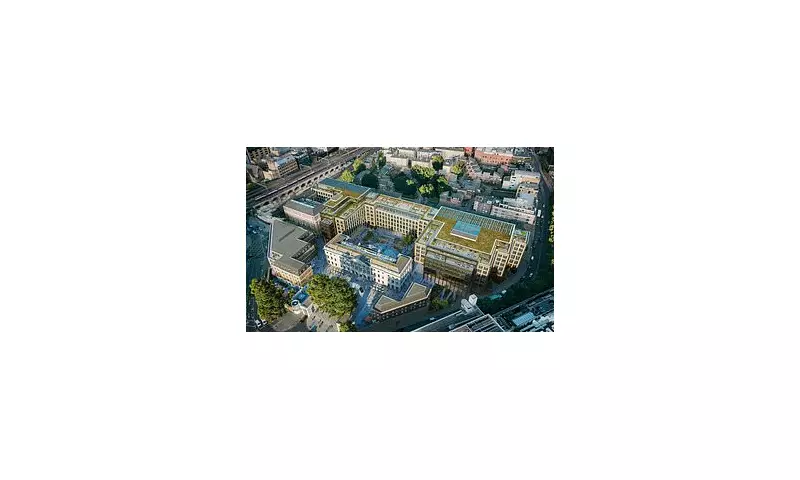
Plans for China's vast new diplomatic compound in London have ignited significant national security alarms, with unredacted documents reportedly revealing a secret underground chamber positioned perilously close to vital communications cables serving the City's financial heart.
The 'Red Flag' Room and Proximity to Critical Infrastructure
According to reports, detailed blueprints for the controversial "super embassy" on the former Royal Mint site show a concealed triangular room in the building's north-west corner. This space measures up to 40 metres across and 2-3 metres deep and features at least two air extraction systems, suggesting it could house heat-generating equipment like high-tech computers.
The chamber's location is a primary cause for concern. It sits just metres away from a crucial cable network running along Mansell Street. These cables, operated by firms including BT, Colt Technologies, and Verizon, carry communications between major financial institutions in the City of London and Canary Wharf, and are close to three major data centres, including the London Stock Exchange.

Documents further indicate that the outer wall of this secret room, which lies directly adjacent to the cables, would be demolished and rebuilt. Security expert Professor Alan Woodward labelled this a major "red flag," stating that having the cables so close would present an "enormous temptation" for a foreign state.
A Network of Concealed Spaces and Intelligence Accommodation
This chamber is not an isolated feature. It is reportedly part of a network of 208 secret rooms beneath the proposed embassy, the majority of which are hidden from public view in planning submissions. Last year, it was revealed that planning documents included so-called "spy dungeons" – two suites of anonymous basement rooms and a tunnel, with their purpose redacted for security reasons.
Diplomatic sources have also indicated that the proposed "spy campus" will provide on-site accommodation for more than 200 intelligence officers. These revelations have compounded fears that the £255 million, 215,280 sq ft complex could function as a significant espionage hub.
Planning Delays and Diplomatic Tensions
The decision on whether to approve the embassy, which requires final sign-off from Housing Secretary Steve Reed, was delayed from an expected date of 10 December. Downing Street cited the need to consider "particular security implications." This delay reportedly risks complicating Prime Minister Sir Keir Starmer's planned first official visit to China, expected between 29 and 31 January.
Beijing has dismissed claims that the embassy could be used for spying, calling the planning delay "completely unjustified." Meanwhile, BT stated it has "robust security measures in place" and works with the government to protect its assets.
Beyond espionage concerns, critics and those who have fled Hong Kong fear the massive diplomatic outpost could be used to monitor and intimidate dissidents on British soil. The future of the site, purchased from the Crown Estate in 2018, now hangs in the balance as security assessments continue.