
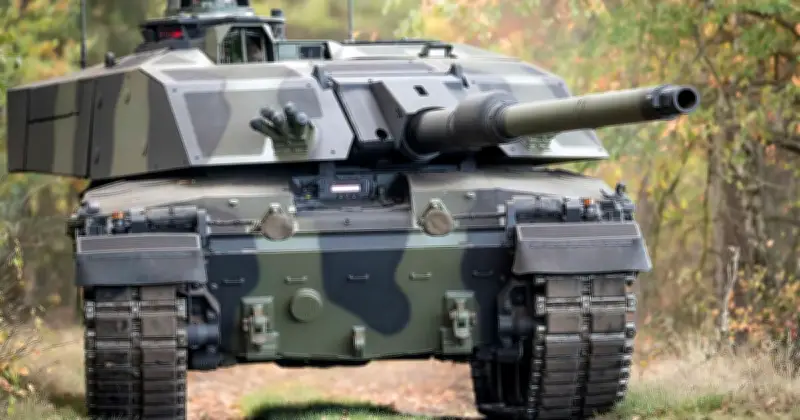
At nearly £9 million each, the UK's 148 new Challenger 3 main battle tanks represent a staggering investment in military capability. Designed to enhance survivability and lethality, these upgraded vehicles—essentially new builds based on Challenger 2 hulls—are expected to dominate modern battlefields at least into the late 2030s. Although not yet in service, the first units rolling off the production line in Telford, Shropshire, as part of a £1 billion joint venture between BAE Systems and Germany's Rheinmetall, have already generated significant interest.
Advanced Features and Value for Money
The Challenger 3 boasts a state-of-the-art turret, active protection systems, a 120mm smoothbore main gun, and other classified onboard equipment operated by four-man crews. According to experts, the price tag is justified. Hamish de Bretton-Gordon, a former tank commander who served in the first Gulf War, highlights even minor improvements like the boiling vessel (BV)—a unique British feature for brewing tea—which has been repositioned five times for optimal placement.
Having commanded Challenger 1 and 2 tanks, de Bretton-Gordon is well-placed to assess the new model. His book, Tank Command, counters claims that heavy armour is obsolete, tracing tank evolution from the British Mark IV to modern designs. He emphasizes that tanks remain peerless due to continuous technical and tactical evolution, coupled with the skill of trained crews.
Ukraine and the Tank's Role
Despite over 6,000 Russian tanks lost in Ukraine to infantry weapons, drones, and other tanks, de Bretton-Gordon argues that heavy armour is far from obsolete. He notes that many armies which abandoned armour are reconsidering in light of the conflict. The Challenger 3, though limited to 148 units, will act as a "force multiplier," integrating with unmanned drones. The UK's Strategic Defence Review indicates that 80% of lethality will come from UAVs, with 20% from tanks, but their combination enhances overall effectiveness.
Ukraine's 14 Challenger 2 tanks have been used as "sniper tanks," engaging targets at up to 3km. According to de Bretton-Gordon, two were hit, but crews survived in both cases, and the tanks were recovered or repaired. This bodes well for the Challenger 3, which features a smoothbore gun capable of firing precision-guided munitions and loitering munitions directed by drones, with a potential range of up to 17km. The new gun also allows a well-drilled crew to fire eight rounds per minute, compared to three or four with the current rifled gun, and the single-part ammunition creates a more spacious interior.
Training and Mass vs. Technology
De Bretton-Gordon stresses the importance of training, contrasting British tank crews—who undergo a year of basic training—with Russian crews, who receive only two weeks and often perish quickly in combat. He also discusses the historical tension between mass and technology, noting that in World War II, Allied mass (16,000 Sherman tanks) overcame German quality (1,000 Tigers and Panthers). However, in Ukraine, poorly trained and commanded Russian forces have seen their numerical advantages nullified.
Reflecting on his own service, de Bretton-Gordon recounts a near-fatal friendly fire incident during the first Gulf War. Major James Hewitt, commanding a Challenger 1 squadron, hesitated to engage what he suspected were friendly forces, despite orders. His caution proved correct when a frantic radio message revealed the targets were de Bretton-Gordon's own squadron. Hewitt's leadership saved lives, and veterans still raise a glass to him.
Tank Command: How the Tank Changed the Face of Battle by Hamish de Bretton-Gordon is published by Headline, priced £22.




