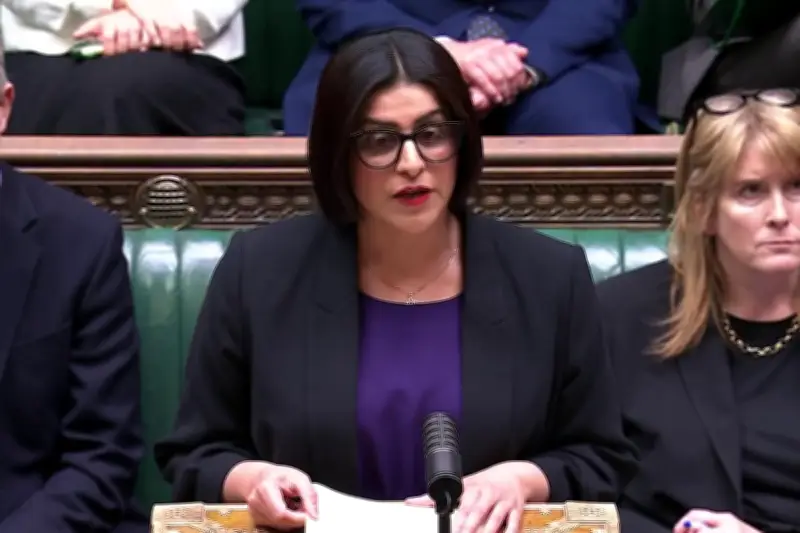
Home Secretary Shabana Mahmood has been accused of attempting to “wave through” changes to criminal law aimed at cracking down on those working for hostile foreign powers. The new legislation would label state-linked organisations such as Iran’s Islamic Revolutionary Guard Corps (IRGC) as threats to national security.
Despite supporting the intention of the National Security (State Threats) Bill, the Conservatives have criticised the Government for allocating only one day in the Commons for MPs to debate it. Shadow Home Office minister Alicia Kearns raised concerns that the lack of line-by-line scrutiny could cause the Bill to “collapse” in a courtroom.
However, Ms Mahmood insisted there is a “need for speed” given recent events and “the threats the country faces”. Prime Minister Sir Keir Starmer had also pledged to fast-track the draft legislation following a series of attacks on Jews in recent months.

The Conservatives pushed a vote on the allocation of time on Wednesday in an attempt to block the Bill from going through all its parliamentary stages in one day. This bid was rejected by 233 votes to 94, a majority of 139.
The legislation follows a recommendation from the Government’s terror law watchdog Jonathan Hall KC, who said existing laws did not cover state-backed groups. Ministers hope the draft law will make it easier to combat threats from hostile states by allowing the designation of groups involved in “foreign power threat activity”. People working for them and their proxies could face up to 14 years in jail under the new powers.
Ms Mahmood told the Commons: “The threat from terrorism is growing and, at the same time, we face foreign powers acting with greater hostility than we have seen at any time since the Cold War. It is essential in the face of this growing threat that we equip those we expect to protect us with the tools they need to do the job, at the moment they need it most. The need for this Bill is therefore great. It gives us a new and powerful tool to tackle hostile states and those who act on their behalf.”
Ms Kearns had earlier said: “Let me be clear from the very outset, we support this Bill, and we want it on the statute book, but we cannot support the manner in which the Government proposes to pass it. This motion makes a permanent change to the criminal law of our country, and it was laid only late Tuesday, and they seek to drive through every single stage in one afternoon. The months of debate this Bill should have had are gone. The line-by-line scrutiny, the votes and amendments at committee stage have all been taken away. So the first test of this law will be in a courtroom where it may well collapse. The case for these powers was made well over a year ago. The House does not exist to wave through legislation. We exist to test it and to find the weaknesses before our enemies do. A motion that forbids us that duty does not strengthen the Bill, it imperils it.”
In response, Ms Mahmood said: “I regret the approach taken by the official Opposition. They know full well that this is a very tightly constructed Bill that takes forward a specific set of recommendations made by the independent reviewer of terrorism and state threats legislation. It will be fully scrutinised by this House and the other place, and the reason for moving quickly, as she well knows, is because we do need this wider power to designate bodies and we will debate this in due course, so that we can move quickly, given the threats the country faces. The need for speed, I believe, is made out by recent events, and I think the Government is doing the right thing.”
Conservative former minister Sir Jeremy Wright said it was the Home Secretary who has “decided there is a lack of time”. He added: “Jonathan Hall KC produced an excellent report, most of which we will all agree with, but he did that in May of last year, so the Home Secretary can’t have this both ways. Either this is a desperately urgent matter, in which case the Government should have brought forward legislation long before now, or it is not. In which case we should have longer than a day to consider it. Should we not?”