

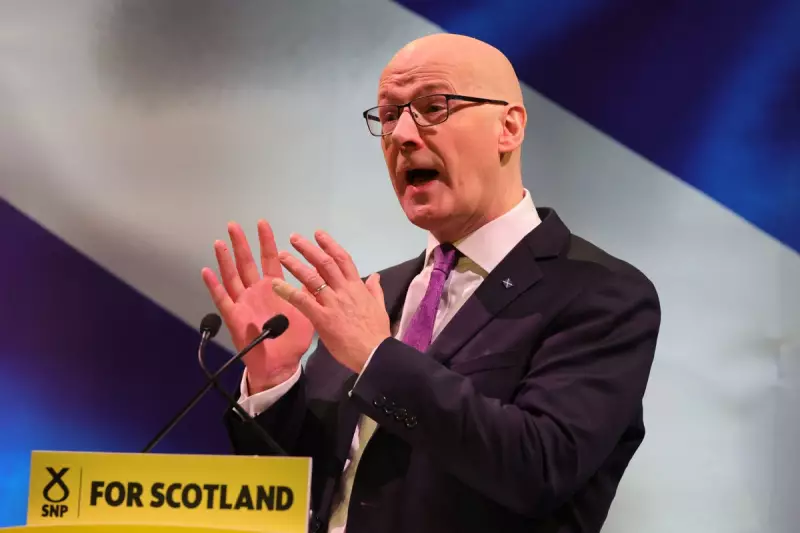
First Minister John Swinney has declared that the Scottish National Party has established the necessary "foundations" for Scotland to thrive as an independent nation. He made the assertion while launching his party's campaign for the upcoming Scottish Parliament election.
Campaign Launch in Glasgow
Addressing SNP members in Glasgow on Monday, Mr Swinney formally kicked off the party's bid for re-election at Holyrood on 7 May 2026. He framed the election as a pivotal moment for Scotland's constitutional future, directly linking a potential SNP majority to the prospect of a fresh independence vote.
The First Minister pointed to his party's lengthy tenure in government, stating it had positioned Scotland for success. "Scotland is by no means a perfect country but, my goodness, given everything thrown at us in recent years, Scotland has strong foundations for the future, under SNP leadership," he told supporters.

The Majority Threshold for a Referendum
Mr Swinney set a clear benchmark for triggering another independence referendum, mirroring the precedent set in 2011. He stated that securing a majority of 65 or more SNP MSPs in the Holyrood election would provide the democratic mandate for a legally recognised vote on separation.
"In 2011, Scotland secured a referendum when the SNP won a majority – it worked in 2011 and it will work in 2026," he argued. "So, on May 7, our aim is not just to win, our aim is to win the overall majority that secures Scotland the right to choose our own future."
Defending the SNP's Record and Future Tactics
In his speech, the SNP leader highlighted what he described as the party's achievements in office, including falling child poverty, a record low in the poverty-related attainment gap in schools, and an unemployment rate lower than the UK average. He also emphasised the growth of Scotland's renewables industry.
However, when pressed by journalists on how he would overcome the UK Government's consistent opposition to granting a Section 30 order for a referendum, Mr Swinney was evasive on specifics. He acknowledged there were different "tactics" available but declined to detail them, instead appealing to democratic principle.
"I think none of my tactics should be necessary… the UK Government should just accept the democratic wishes of the people of Scotland," he stated after his speech, expressing frustration at Westminster's stance.
A Democratic Principle at Heart
The First Minister concluded his campaign pitch by framing the push for a referendum as a fundamental democratic issue. He invoked the precedent of the 2014 vote, arguing that the right of the Scottish people to decide their future was a principle previously accepted by the UK.
"It comes down to a fundamentally basic democratic point," Mr Swinney said, "which is the people of Scotland have the right to decide their own constitutional future and that is a fundamental democratic principle that has to lie at the heart of our politics in Scotland today."






