

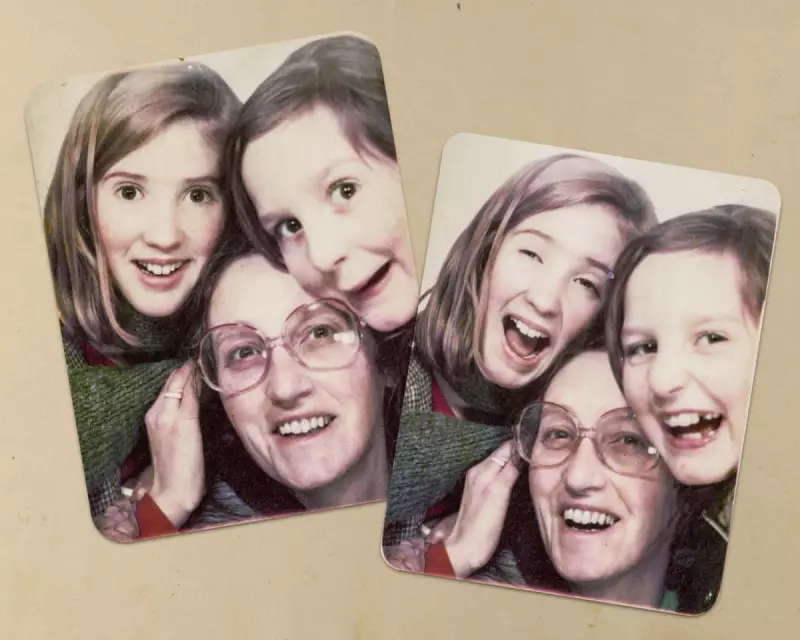
For years, Zoe and her sister Stacey endured their mother Gwen's sweeping characterisation of their teenage years in the mid-80s to early 90s. They were, according to her legend, delinquent, stroppy, and utterly disengaged from the world's pressing political issues. It was a family narrative firmly set in stone, until a collection of old photographs told a startlingly different story.
The Family Legend of Stroppiness and Disinterest
Gwen, a fiercely politically engaged woman, painted her daughters' adolescence with a broad, critical brush. The year 1986 was simply "the year Stacey was awful." Zoe, meanwhile, was deemed a delinquent from whom "you couldn't get a word of sense." The photographic evidence Gwen curated seemed to support this: shots of Zoe sarcastically sniffing a geranium, or Stacey caught mid-eye-roll outside a European cafe, seemingly telling the camera to "piss off."
Their home in Wandsworth was a hub of progressive activism, plastered with posters on issues from pit closures to nuclear disarmament. Gwen created spoof public information campaigns, replacing government "Protect and Survive" nuclear advice with her own "Protest and Survive" posters. Her constant refrain was bewilderment that her daughters seemed unbothered by the demise of the Greater London Council (GLC) or the threat of nuclear war, despite their frequent presence at protests with her.

A Photobooth Picture Tells a Different Story
The process of compiling a photo montage for Gwen's funeral prompted a profound reassessment. Pictures sent by her friends revealed an alternative narrative. In stark contrast to the legend of perpetual teenage angst, many images showed Zoe and Stacey with genuinely sunny dispositions. The most compelling evidence came from a simple photobooth strip.
"Here we all are in an extremely tight space, smiling," Zoe recalls. The cramped intimacy of the photobooth made the genuine warmth of the moment undeniable. It was a silent but powerful rebuttal to the long-held family lore. "We're plainly not, as her legend had it, allergic to her," Zoe notes, acknowledging that while their dynamic wasn't the glamorous fun of the Gilmore Girls, it wasn't the adversarial struggle Gwen had described either.
Reconciling Memory with the Evidence
This photographic discovery forced a re-evaluation of shared history. Gwen had framed their later childhood as a cross between the adversity of Tenko and the demonic possession of Rosemary's Baby. The new-found images suggested a more nuanced, ordinary reality. They also challenged Gwen's claims of their apathy, such as the assertion that the girls "didn't even notice" the outbreak of the Iraq war—a statement Zoe now firmly disputes.
The lack of photographic proof from protests, deemed frivolous by their mother, had allowed the myth of their disengagement to flourish. The only verifiable records of their activism were clippings in the Wandsworth Borough News. The photobooth shot, therefore, became more than a memento; it was a testament to resilience and a challenge to a dominant, perhaps unfairly critical, parental narrative. It proved that even in a household dedicated to protesting the world's injustices, the personal story could still be ripe for reinterpretation.






