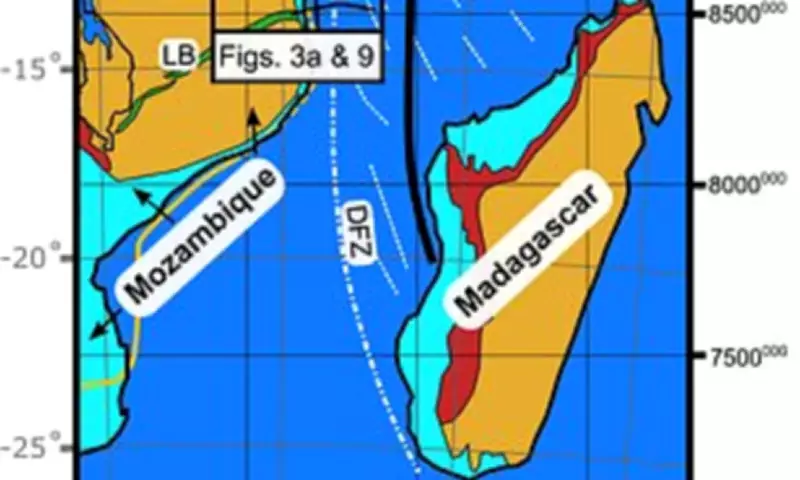
Scientists have discovered a massive tectonic boundary hidden beneath Africa, stretching from Mozambique to Tanzania. This ancient fault line, named the Rovuma Transform Margin, extends over 310 miles (500 km) and marks the boundary between the continent and the ocean. Researchers believe this previously unknown structure will reshape our understanding of how Earth's continents shift over millions of years.
Discovery of the Rovuma Transform Margin
The Rovuma Transform Margin is not an active fault like California's San Andreas Fault, but a 'fossil fault' left over from when tectonic plates tore apart. Scientists think it formed during the Jurassic period as the supercontinent Gondwana broke up. Over time, sediment from the Rovuma River buried the fault, altering Africa's coastline. Since the 1980s, geologists debated the existence of a hidden fault along East Africa's coast, but new technology has confirmed it.
How Scientists Detected the Fault
Using satellite gravity measurements and seismic reflection—a technique akin to a 'giant ultrasound scan' of the Earth—the team peered beneath the surface. They found a rapid transition between continent and ocean, with the crust thinning by up to 18 miles (29 km) over just 10 miles (17 km). This 'giant scar' marks Africa's dramatic transformation tens of millions of years ago.

Role in Africa's Splitting
Africa is already splitting along the East Africa Rift System (EARS), cracking into the Nubian and Somali plates. Co-author Dr. Jordan Phethean from the University of Derby explains that the Rovuma Transform Margin acts like 'railroad tracks' guiding these plates apart. It may also allow plates to rotate more easily in one direction due to reduced tectonic resistance. The fault likely played a key role in tearing Madagascar away from Tanzania around 100 million years ago.
Future Implications
In the next few million years, the fossil fault will continue guiding the Nubian and Somali plates as they break apart. Eventually, tectonic stresses may reactivate the fault, causing earthquakes and facilitating plate motion. Dr. Phethean notes that long-offset transform faults like this may dictate plate motions, not just result from them. This could lead to the formation of a new supercontinent, similar to Pangea.
The discovery underscores the dynamic nature of Earth's geology, with continents constantly shifting over millions of years.