

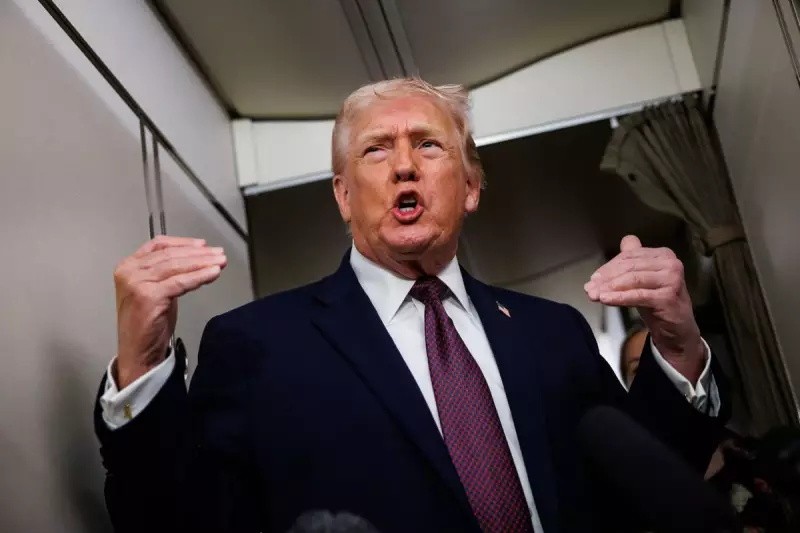
It is time for Washington to step up and halt Donald Trump's aggressive manoeuvres, argues Anne McElvoy. The president has bulldozed through the domestic guardrails designed to keep US leaders in check, but there are emerging signs that America's constitutional immune system is turning against him. Monday 26 January 2026 11:53 GMT marks a critical juncture, with just 12 months into Trump's first year back in office, the political landscape is heating up over the chilly topic of Greenland and its pivotal role in Arctic security.
A Transatlantic Game of Chicken Over Greenland
The tetchy US-Europe relationship is being strained to breaking point as tensions escalate. Think of this Trump versus Europe brawl as a massive game of chicken, where every player has something to be angsty about. Greenland's security faces real and pressing threats from Russia, alongside a Chinese push to invest heavily in the North Sea shipping channel. This aims to cut sailing times between the Pacific and Atlantic by passing north of Russia, a route made more accessible as climate change melts the ice sheet. Moreover, Greenland's critical minerals are hotly sought after, shifting this remote Arctic landmass from the far northern sidelines to centre stage in European concerns.
Trump's Expansionist Lunge and Its Global Repercussions
The manner of Donald Trump's lunge for control, including his declaration that he needs to "have Greenland," signals a fierce new era of presidential expansionism. This move busts apart the remnants of the ragged "rules-based order" that traditionally prohibits states from making territorial lunges at countries they deem strategically important. In this case, Trump argues that Denmark, which administers Greenland's security and foreign policy, should cede control of the island to the US on a "might equals right" basis, inevitably favouring America.

Adding to the anxiety is the impact of a threatened new round of tariffs on the UK and Europe, framed as revenge for standing up to the US over Greenland. As an American president in a pugnacious mood, alongside core members of his administration, descends in full security pomp on the World Economic Forum at Davos, the pressing question is: which chicken blinks first? It is a crowded coop, for sure, with multiple stakeholders on edge.
UK and European Responses to the Crisis
On the UK side, Keir Starmer is correct in stating that talking about cancelling the King's visit to the US is an unwise retaliation idea. Such a move drags the royals into the political dirt fight and is unlikely to soften Trump's heart regarding dropping extra tariff threats towards Britain. The decision to join NATO and much of Europe in pushing back against the US idea of a "total and complete" purchase of Greenland has already cooled relations significantly. However, it is possible that the US, rather than Europe, holds the key to how this crisis unfolds.
Domestic US Checks and Balances Under Pressure
Two interlinked elements inside the US could be game-changers in a crisis that is ostensibly about a thinly populated Arctic landmass but is more fundamentally about the scope and limits of US authority. One is the constitutional court, and the other is Congress, which has been largely supine on Trump's punitive use of tariffs. Yet, unease is stirring at the economic cost borne by US consumers when trade dries up and prices rise.
At home, the president has rewritten a host of rules and ditched checks and balances at will, often wrong-footing his foes by proceeding without heed to objections or laws. He has had some cover on tariffs after Republican leaders implemented a policy last year that blocked attempts to overturn them by returning the matter to the "floor" for debate and voting. That prohibition expires in the next week or so, adding urgency to the situation.
The Supreme Court's Pivotal Role
Even sooner, possibly this week, the mighty Supreme Court ruling will drop on the legal basis, or lack thereof, for tariffs. This decision might well sway opinion in Congress and among some Republicans who are getting twitchier about the repeated hammer blows to trade by a mercurial president. Trump's former vice-president, Mike Pence, is the latest of a growing number of Republicans publicly opposing his administration's efforts to acquire Greenland.

The court, a mix of senior judges with widely differing stances on interpreting the constitution politically, was swayed heavily rightwards during the first Trump era. Yet, it does still rule inconveniently at times, as seen recently in Trump v Illinois, where it judged that the administration did not have the right to impose the National Guard on Illinois over the head of its Democratic governor to quell protests at immigration raids.
That could serve as a template for another move tying Trump's hands, with two lesser courts ruling that the president has encroached on powers that rightly belong to Congress as the legislative branch, not the presidency, regarding tariffs. However, this may be what one senior Democrat legal adviser calls "wish-casting," putting an optimistic gloss on a more likely outcome where the court backs Trump on tariffs.
Administration's Stance and Potential Fallout
This is certainly the view of the powerful Treasury secretary, Scott Bessent, due to arrive in Davos as the senior economic voice in the administration on Tuesday to meet with the world's top business leaders and some nervous finance ministers. He has argued that the court should uphold Trump's argument on the intriguing logic that "the national emergency is avoiding a national emergency" – meaning that giving America more direct control of Greenland would stave off a wider geopolitical crisis. It is a neat, if perhaps sweeping, legal case.
Overturning a signature economic policy would infuriate Trump, who might well find other ways to effectively impose punitive measures. Ironically, for a president who distrusts climate change action, this could involve boosting carbon taxes on imports that are emissions-heavy in their production. In short, where there is a will to wield tariffs as a weapon, Trump can doubtless find a way to do so.
Strategies for Mitigation and the Path Forward
The argument is more pragmatically about whether a united pushback from Europe, deploying figures he trusts such as Italy's Giorgia Meloni to mitigate Trump's heated threat of more levies that would further silt up transatlantic trade, might be more productive. The optimist case is the "taco" strategy – "Trump always chickens out." This means that when markets react negatively to his tariff threats by getting "the yips," as the president once put it in an obscure golfing reference, he eventually reaches some less heated agreement.
But this time, it feels fiercer. As all good political and business investors know, past performance is no guide to future returns. The "yips" are therefore back in abundance as the gap in Atlantic understanding widens by the day, and a president with a mission descends to ruffle the feathers of European leaders and global business elites huddling in the Alps.
Anne McElvoy is executive editor of Politico and co-host of the 'Politics at Sam and Anne's' podcast, providing sharp insights into this unfolding geopolitical drama.





