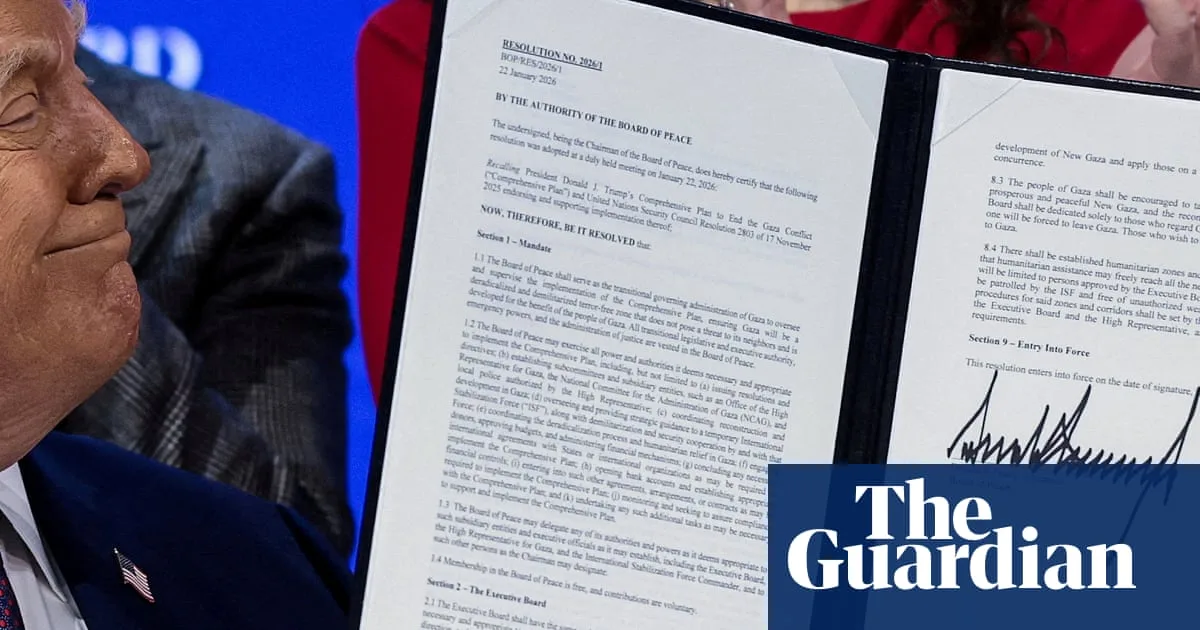
Trump's Davos Board Launch: A Personal Project Disguised as Peace Initiative
The formal unveiling of the 'Board of Peace' at the World Economic Forum in Davos on Thursday has sparked intense scrutiny and concern among international observers. Rather than presenting a genuine framework for conflict resolution, the charter of this new body suggests a troubling pivot from the 'America First' doctrine to what critics are calling 'Trump Always'. This initiative appears designed less to address global crises and more to serve the personal ambitions and ego of its creator.
A Charter of Personal Power, Not Collective Governance
Examination of the board's founding documents reveals an extraordinary concentration of authority in the hands of one individual. The charter explicitly names Donald Trump himself as permanent chair, granting him unilateral power to determine his successor, set the agenda, and remove any member at will – including those who have contributed the substantial $1 billion required for permanent membership. This structure represents the institutional embodiment of Trump's frequently stated belief that he is constrained not by established legal frameworks but by his own personal morality and judgement.
The board's very symbolism reinforces this personalisation of international institutions. Its logo appropriates the globe and laurels motif of the United Nations, rendered in gold – a clear nod to Trump's aesthetic preferences – while curiously minimising geographical representation beyond North America. This visual messaging underscores the board's departure from traditional multilateral approaches to global governance.
From Gaza Reconstruction to Personal Legacy Building
The board's origins trace back to a United Nations Security Council resolution authorising a peace-building body to oversee administration and reconstruction efforts in Gaza. Despite significant reservations about the colonialist implications of this model and the extraordinary latitude granted to the US president, the resolution's deliberate vagueness and the perceived necessity of securing Trump's cooperation for ceasefire efforts facilitated its passage.
What has emerged from this authorisation, however, bears little resemblance to the anticipated Gaza-focused initiative. Astonishingly, the board's charter makes no mention of Gaza whatsoever. Instead, it establishes an 'international peace-building body' explicitly intended to replace what it characterises as 'failed' existing institutions. This raises profound questions about whether this represents a genuine attempt to supplant the United Nations or merely another platform for amplifying Trump's personal brand and satisfying his desire for recognition as a global peacemaker.
Questionable Membership and Diplomatic Fallout
The composition of the board's membership has further undermined its credibility. Alongside Trump, the board includes Benjamin Netanyahu – another leader facing indictment by the International Criminal Court – alongside representatives from Belarus, Uzbekistan, and Hungary. While eight Muslim-majority nations, including Saudi Arabia, Egypt, and Turkey, have agreed to participate, traditional American allies are notably absent.
Trump's diplomatic missteps have compounded these concerns. His premature announcement that Vladimir Putin had joined the board – promptly contradicted by the Russian leader – provided convenient justification for the United Kingdom and other nations to distance themselves from what was presented as an unrefusable offer. This episode demonstrates how Trump's characteristic tendency to overplay his hand continues to hamper his international initiatives.
Palestinian Marginalisation in Governance Structure
The board's organisational hierarchy reveals particularly troubling implications for Palestinian representation. While an executive board featuring figures like Tony Blair and Jared Kushner (Trump's son-in-law) occupies the highest tier, and a Gaza executive board contains regional officials, Palestinian representatives have been relegated to a fourth-tier technocratic committee. This marginalisation occurs as approximately two million Palestinians endure a brutal winter amidst ongoing bombardment and the ruins of their communities.
Recent presentations by Palestinian and US officials outlining plans for the next hundred days at least suggest that administrative attention hasn't completely abandoned Gaza. Kushner's ambitious proposals, which include increased aid delivery, reopening of the Rafah crossing, and reconstruction of essential infrastructure including homes and hospitals, may disappoint those on the Israeli right who advocate for complete Palestinian displacement. However, fundamental questions remain about what will actually materialise from these plans and under what conditions.
The Perilous Path Forward
Trump's well-documented fixation with real estate development and his desire for recognition as a peacemaker might represent the best hope for maintaining his engagement with Gaza's reconstruction and potentially reducing Netanyahu's influence over the process. However, the current framework treats Palestinian rights as peripheral concerns rather than central principles.
This cannot be allowed to stand. While Trump has repeatedly demonstrated contempt for international law and multilateral institutions, other nations must continue to defend these frameworks. The already formidable challenge of achieving peace in Gaza and justice for Palestinians has been further complicated by this new structure that prioritises personal legacy over principled governance. The international community faces the difficult task of engaging with immediate humanitarian needs while resisting institutional frameworks that undermine the very principles necessary for lasting peace.




