

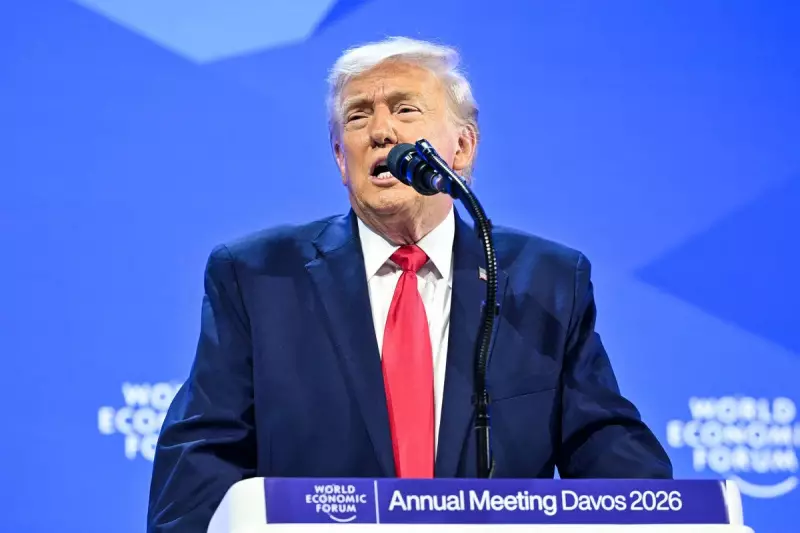
Former US President Donald Trump has robustly defended his contentious tariff policies, asserting that they were specifically designed to compel foreign nations to compensate for the damage they have inflicted. In a notable address delivered at the World Economic Forum in Davos, Trump articulated a firm stance on international economic relations, framing his approach as one of accountability and reparation.
Trump's Justification for Tariffs at Davos
During his speech, Trump explicitly stated, "We are imposing taxes on nations to make them pay for the damage they've done." This declaration underscores his long-held view that the United States has been economically disadvantaged by its global trading partners, and that tariffs serve as a necessary mechanism to rectify this imbalance. His comments come at a time of heightened geopolitical tensions and ongoing debates about the efficacy and consequences of protectionist trade measures.
Criticism of Europe's Trajectory
In addition to his remarks on tariffs, Trump launched a pointed critique of Europe, describing the continent as "unrecognizable" and asserting that it is "not heading in the right direction." This criticism reflects his broader scepticism towards traditional alliances and multilateral cooperation, themes that have characterised his political career. The speech at Davos provided a platform for Trump to reiterate his nationalist and populist perspectives on the global stage.

Greenland Controversy and Diplomatic Disruptions
Trump's address coincides with ongoing international concern over his repeated threats to forcibly seize Greenland, a territory of Denmark, which is a member of NATO. These threats have raised serious questions about the integrity and stability of the alliance, prompting unease among world leaders. Prior to his departure for Davos, Trump indicated that he had numerous meetings scheduled to discuss Greenland, highlighting the issue's prominence in his foreign policy agenda.
Logistical Setbacks Impact Diplomacy
However, Trump's diplomatic engagements faced immediate disruption due to a three-hour delay in his arrival, caused by an electronic fault on Air Force One. This technical issue led to the cancellation of a planned meeting with German Chancellor Friedrich Merz, underscoring the logistical challenges that can impede high-level international dialogue. Such setbacks add a layer of complexity to an already tense geopolitical landscape, as leaders grapple with Trump's unpredictable statements and actions.
The combination of Trump's tariff justifications, his criticism of Europe, and the ongoing Greenland controversy paints a picture of a former president continuing to shape global discourse through provocative rhetoric and contentious policies. As world leaders convene at forums like Davos, his influence remains a significant factor in international relations, driving discussions on trade, security, and alliance dynamics.






